In the early months of the Great Depression, Herbert Hoover was fond of saying that “prosperity is just around the corner.” At the same time, millions were losing their jobs, facing utility shut offs and evictions, moving into tent encampments and shantytowns, and standing in bread lines that stretched for hours. In 1929 there was no public social safety net or welfare programs, not even as we know them in their fractured form today. Instead, the state’s response was to attend to Wall Street and direct the poor and newly-dispossessed toward a patchwork and intolerant system of private relief agencies and religious aid organizations. Denying the government had any larger responsibility for its people, Hoover would later explain that “the basis of successful relief in national distress is to mobilize…agencies of relief help in the community. This has been the American way.”
Abandoned and left to fend for themselves from the scraps of a system of charity, many among the ranks of the poor took survival into their own hands. They marched in unprecedented numbers against hunger and unemployment, led daring wildcat strikes and other militant actions from industrial plants in the Midwest to tenant farms in the Delta, and created mass organizations like the Unemployed Councils, formed through the Communist Party. These multi-racial Councils developed in cities across the country around relief for unemployed workers, preventing or reversing thousands of evictions and gas and electricity shutoffs, among other activities. They worked locally to address their immediate, overflowing needs, but in the early years of the Great Depression they also became a political home for tens of thousands of poor people: central to the Councils’ vision was political education, leadership development, and larger forms of collective agitation and struggle.
[aesop_image img=”https://kairoscenter.org/wp-content/uploads/2020/05/image28-1.jpg” panorama=”off” imgwidth=”80%” alt=”Unemployed Councils” align=”center” lightbox=”on” captionsrc=”custom” caption=”Unemployed Councils protest during the Great Depression.” captionposition=”left” revealfx=”off” overlay_revealfx=”off”]
Just a few years later, the Social Security Act and other major government programs were created. This history is often told crediting Franklin D. Roosevelt and a handful of supposedly transcendent politicians, but it was the collective efforts of masses of people that forced the government into action. Roosevelt himself did not have dreams of fundamental change for the poor and, by the end of the 1930s, the New Deal became a constrained political project that saved American capitalism from itself. The significant public concessions that it did make were instead the result of poor people taking action together.
[aesop_quote type=”block” background=”#31526f” text=”#ffffff” align=”left” size=”1″ quote=”The New Deal became a constrained political project that saved American capitalism from itself. The significant public concessions that it did make were instead the result of poor people taking action together. ” parallax=”off” direction=”left” revealfx=”off”]
Today, we confront another economic collapse amid a vicious pandemic. In the last six weeks, we’ve witnessed the accelerated redistribution of wealth from the poor to the most rich. The government has funneled trillions of dollars into Wall Street, while the recent stimulus packages still don’t provide tens of millions of people with paid sick leave, sustained financial support, healthcare and housing protections, and more. These millions are now lining up behind the 140 million who were already poor or one emergency away from poverty.
This multitude must protect themselves and their communities in the shadow of a government that has abandoned them in ways that strikingly echo the Hoover administration. Within this context, many have turned to the idea of mutual aid. Community groups and ad-hoc neighborhood associations are springing up to coordinate the sharing of food and supplies; nonprofits are funneling their shrinking budgets toward direct service projects; online organizations are offering virtual trainings; even Alexandria Ocasio-Cortez has shared a “how-to” guide on the subject.
The lengths to which people are laboring to take care of one another during this crisis is inspiring and necessary. All across the country, we are seeing the truth: that poor and dispossessed people, as well as all those now awakened to a new kind of precarity, will not wait to be saved, but will, as always, take lifesaving action born out of necessity. As long as this crisis rages, there will be people who do the necessary work of triage, of meeting immediate needs in the present, and this work is critical. But in the face of a brutal and increasingly volatile system, mutual aid as it is generally being conceived may be a bandaid, rather than a strategy to win what every person needs in order to live.
[aesop_quote type=”block” background=”#31526f” text=”#ffffff” align=”left” size=”1″ quote=”In the face of a brutal and increasingly volatile system, mutual aid as it is generally being conceived may be a bandaid, rather than a strategy to win what every person needs in order to live.” parallax=”off” direction=”left” revealfx=”off”]
For many concerned citizens, the response to this moment has been to emulate a non-profit service model for those most at risk. This is a position of stop-gap charity that takes care of a small number of people, but does little to address the deeper source of pain for so many. For others, mutual aid has become a project of rejecting and resisting the state and its decrepit and hateful institutions; this is a posture that claims that no one is coming to save us, that our communities have all that we need, and that we can somehow transform our conditions by coming together through networks of social solidarity. In both cases, good people are doing brave work and some are receiving emergency relief because of it. But mutual aid at this level makes no claim on the state and no counterattack toward capital to solve the problem of this pandemic and the economic crisis beneath it.
Over the past fifty years, the ruling class has mounted devastating attacks on public institutions and services, from privatized healthcare and education to the evisceration of the social safety net. Meanwhile, the economy has undergone a technological revolution, and with it our society has been (re)constructed in the image of global capital. We’ve seen the hollowing out of the state and the forfeiture of many of its functions to non-profits, the private sector, and the free market. We’ve been made increasingly dependent on market-based solutions that lionize billionaires and trumpet apolitical acts of service.
Now, in this moment of crisis, we do what we can to salvage our communities, often using the same models, while corporations are celebrated for their humanitarianism even as they reap the rewards of federal relief. Neoliberal capitalism and decades of austerity measures have conditioned generations of us to ignore or lose faith in the possibility of the state as a site for organized struggle. But it will take the resources of our government and of governments around the world to not only overcome the coronavirus, but to fundamentally change our lives for the better.
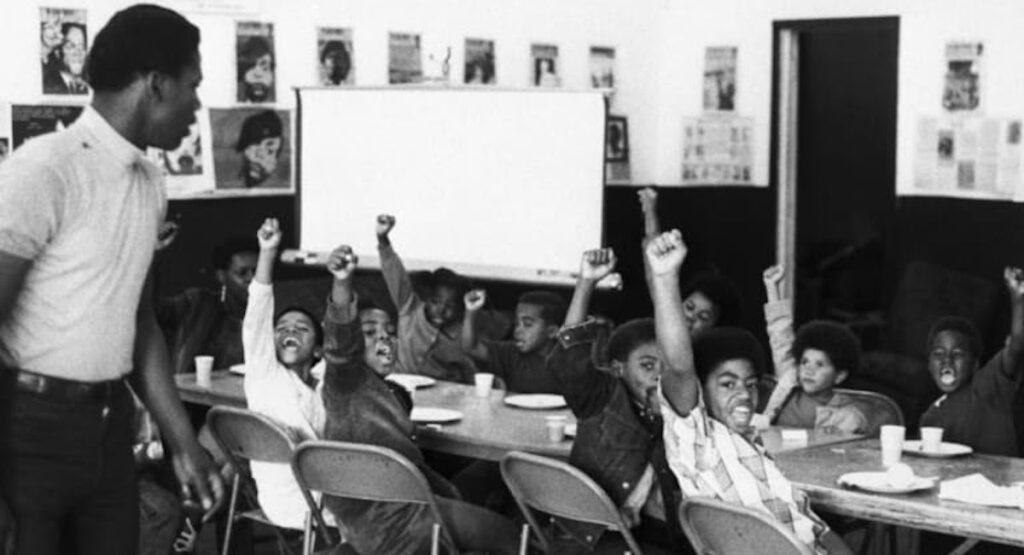
What, then, does this moment require of us? In the last few weeks, many have turned to history to better understand how people have responded to crises in the past. The 1918 flu pandemic and the Great Depression are understandable reference points; another is the work of the Black Panthers and their free breakfast program in the early 1970s. The free breakfast program has recently been lifted up as a leading model of mutual aid; one popular narrative is that the free breakfast program, which fed tens of thousands of children, is a key example of how marginalized communities care for themselves in the absence of and counter to the state.
[aesop_quote type=”block” background=”#31526f” text=”#ffffff” align=”left” size=”1″ quote=”At the onset of a new and regressive world order, the Panthers saw their programs as a way to build a movement that could spark larger political change.” parallax=”off” direction=”left” revealfx=”off”]
What is forgotten is the political orientation of the breakfast program, which moved beyond the realm of mutual aid as we often understand it. The Panthers initiated the program not just to feed people, but to actively and purposefully demonstrate the failures of Johnson’s War on Poverty and the contradictions of a nation whose enormous wealth — and enormous racism — was increasingly being marshaled to hurt and impoverish a majority of people at home and around the world. At the onset of a new and regressive world order, the Panthers saw their programs as a way to build a movement that could spark larger political change. This meant that all of their community work was interwoven with deep political study and analysis, highly visible protest, sophisticated communications and cultural organizing, and a commitment to sustaining leaders who could stick and stay for the long-haul. And while deeply rooted in poor black urban communities, the Panthers also inspired and connected with similar efforts of Latino and poor white organizations, as well as efforts of the poor in other parts of the world.
These were treacherous waters. At the time, J. Edgar Hoover and the FBI listed the Black Panthers and their breakfast program as “the greatest threat to internal security in the country.” The government recognized that the program represented the kind of mutual aid that could catch fire across the wide populations of poor and dispossessed people who had been abandoned by the War on Poverty and a hyper-racist society. The Panther’s ability to clearly demonstrate this abandonment, unite leaders within their communities, and build relationships with poor people across lines of division was a weapon far more powerful than the guns they carried. If these programs had just been a question of direct service or insular mutual aid, the government wouldn’t have hunted the Panthers down. They would have simply ignored them.
[aesop_image img=”https://kairoscenter.org/wp-content/uploads/2020/05/how-the-black-panthers8217-breakfast-program-both-inspired-and-threatened-the-governments-featured-photo.jpg” panorama=”off” alt=”Black Panthers” align=”center” lightbox=”on” captionsrc=”custom” caption=”The Black Panthers’ free breakfast program in the 1970s.” captionposition=”left” revealfx=”off” overlay_revealfx=”off”]
In the early 1990s, as homeless leaders with the National Union of the Homeless were taking over vacant, federally owned housing, they studied the experience of the Panthers. In that history, they saw revolutionary leaders who were beginning to understand that in order to end their suffering, they would need new forms of organization that could confront the government and the ruling class head on. During these housing takeovers, homeless leaders identified “The Six Panther Ps”, lessons that they drew from that history: 1. Program 2. Protest 3. Projects of Survival 4. Publicity Work 5. Political Education 6. Plans not Personalities. These organizing cornerstones, they explained, were inseparable from one other. There needed to be a political program — a vision and set of values — that was built through direct action, strong communications, political education, leadership development, and a politicized and militant form of mutual aid that the Homeless Union called “Projects of Survival.” They explained:
Our organizing attracts people on the basis of their immediate needs — food, housing, childcare, etc. Activities like tent cities and housing takeovers are designed to meet people’s needs and build organization in the process. As we come together to meet our common needs, opportunities for political education and other key elements arise. We have tremendous strength by virtue of addressing the problems which people are struggling with day-to-day. However, we don’t just try to meet people’s individual needs — we use that struggle to fight for everyone’s needs to be met.
The Homeless Union emerged as a response to the explosion of homelessness in the 1970s and 1980s, as the government demolished public housing and funded urban development projects that fueled gentrification. Poor and homeless communities quickly began to organize. They opened their own shelters and led takeovers of vacant houses owned by the Department of Housing and Urban Development, because there were more houses sitting empty then there were homeless people. These were their projects of survival: they secured housing and the other resources necessary to fuel the birth of a movement to end poverty, led by the poor. As they began to win new protections and expanded rights for their communities, their slogan became “Homeless not Helpless.”
[aesop_image img=”https://kairoscenter.org/wp-content/uploads/2020/05/nuh.jpg” panorama=”off” alt=”National Union of the Homeless” align=”center” lightbox=”on” captionsrc=”custom” captionposition=”left” revealfx=”off” overlay_revealfx=”off”]
Projects of survival do many things: they meet the needs of people who can then come into new political consciousness; they encourage and secure leaders who have a sense of their own agency and political clarity; they connect to political programs that rely on many different tactics and strategies; they expose the larger society to the moral failures and contradictions of governing systems; and they make demands and claims on the power of the state. Those who take up projects of survival are the first to feel the pain of injustice and the first to sound the alarm against it. They take action from a position of necessity and life-or-death struggle: this emerges organically as people do what they need to survive, but also requires deep strategy and the collective genius of whole communities of people to secure those needs. At the very core, these projects are woven into a political and moral imagination that emphatically believes in the power of poor people to be agents of change, not just subjects of a cruel history.
[aesop_quote type=”block” background=”#31526f” text=”#ffffff” align=”left” size=”1″ quote=”At the very core, these projects are woven into a political and moral imagination that emphatically believes in the power of poor people to be agents of change, not just subjects of a cruel history.” parallax=”off” direction=”left” revealfx=”off”]
There are many such examples of these projects of survival in US history. The Unemployed Councils and other organizing efforts during the Great Depression could have been called projects of survival; a hundred years earlier, the Underground Railroad could have as well. The decades-long work of those escaping bondage, and of their compatriots in free states, met the dire needs of many and challenged the economic, political and ideogoical systems of slavery. The revolutionary motion of hundreds of thousands of people smuggling themselves out of slavery ignited a movement whose material and moral intervention was irrefutable by the 1850s. Because of these leaders, no one in the country could be neutral on the question of slavery and, although half the nation may have disagreed, there could and would never be a return to “normal.”
Today, in the midst of a crisis that will reshape our world, we are seeing projects of survival all over the country, some that are already impossible to ignore and others that are quietly but quickly building. In the first few weeks of this virus, poor people in a number of cities won moratoriums on evictions and utility shutoffs. In Detroit, the People’s Water Board, Michigan Welfare Rights Organization, and others forced the city government to enact a moratorium on water shut offs and to turn water service back on for $25. For them, this is a short-term victory that is connected to their decades-old fight around the right to water and the welfare system. In Northern California, Moms 4 Housing and the California Homeless Union have taken over vacant houses and organized to protect tent encampments as they continue to do groundbreaking political work among the homeless. Further south, the Los Angeles Tenants Union, made up of neighborhood organizations of the poor, has gone into action to care for their communities while also echoing the call for a rent strike that’s now resounding across the country.
[aesop_image img=”https://kairoscenter.org/wp-content/uploads/2020/05/hahnemann_april2020.jpg” panorama=”off” alt=”Put People First! PA” align=”center” lightbox=”on” captionsrc=”custom” caption=”Put People First! PA protests outside the closed Hahnemann University Hospital in Philadelphia.” captionposition=”left” revealfx=”off” overlay_revealfx=”off”]
In Pennsylvania, Put People First! PA built projects of survival long before this crisis: they’ve recently fought the closure of rural hospitals across the state and just last year helped to erase the medical debt of thousands of people. They have positioned leaders across the state who understand that a transformative movement of the poor will require permanent and independent political organization. Projects of survival are core to their organizing and, much like the Black Panthers, are part of a wider political program that also involves communications, political education, leadership development, and creative protest. In the last six weeks, as the coronavirus has halted life in Pennsylvania, they have turned both inward to consolidate their leaders and outward to insist that this crisis should not exist. In early April, they left their homes in Philadelphia with an abundance of caution to protest outside of Hahnemann Hospital, which was recently bought by a venture capitalist who attempted and failed to extort the city for millions of dollars in order to reopen it. Now, Hahnemann sits empty while people die.
In this moment of widening poverty and inequality, the leadership we desperately need will not come from the rich, from corporations, or from nonprofit models that provide triage but do not demand change. If we are to build a nation that cares for all people, it will be through the leadership of hundreds of thousands of politicized poor people and mass organizations of the poor. It will be because of leaders who recognize that the only way to break free of the bitter cycle of simply surviving is through a broad movement of the poor and dispossessed that can rally our society into action.
Some have argued that through this disaster we cannot allow a return to normalcy, that normalcy never worked for the majority of people anyway. But the truth is that normal no longer exists. The order of the past is gone. Now the only direction is forward, and it will be the poor already standing in the breach of the old wounded world who will help usher us into the new.