The gospel at its best deals with the whole man, not only his soul but also his body, not only his spiritual well-being, but also his material well-being. Any religion that professes to be concerned about the souls of men and is not concerned about the slums that damn them, the economic conditions that strangle them and the social conditions that cripple them is a spiritually moribund religion awaiting burial.
– Rev. Dr. Martin Luther King, Jr. (Pilgrimage to Non-Violence, 1960)
[aesop_image img=”https://kairoscenter.org/wp-content/uploads/2015/03/image3.jpeg” align=”left” lightbox=”on” caption=”Rev. Erica Williams at the Moral March on Raleigh” captionposition=”left”]
As I journeyed to the Moral March HKonJ in North Carolina with The Kairos Center for Religion, Rights and Justice from Union Theological Seminary, these words from the great drum major for social justice kept resounding in my ears. The Moral March on Raleigh became for me a kairos moment that “rekindled the flame,” as the fire I once had for religion had been extinguished. As a licensed Baptist minster, for years I have struggled with the concept of church and its role in the community. As a native of Saginaw, MI a place where crime, poverty and racism have caused a sense of despair and hopelessness for many, I had lost faith in a religion that was created to set those who are oppressed at liberty. I never lost my faith in God but I struggled day and night with religion as I saw record numbers of children living in poverty, people being killed daily at the hands of gun violence and so much more. With more than three hundred churches in the Saginaw, and a population of 50,303, it was disheartening to see people of faith continue to live life and conduct business as usual while the people in the city die daily from lack of basic needs. This caused me to turn away from a tradition that I had known since early childhood.
As a follower of Jesus Christ I believe that he gave us our marching orders as the church in Luke 4:18-19 (NKJV):
18 The Spirit of the Lord is upon Me, Because He has anointed Me To preach the gospel to the poor; He has sent Me to heal the brokenhearted, To proclaim liberty to the captives And recovery of sight to the blind, To set at liberty those who are oppressed;
19 To proclaim the acceptable year of the Lord.
This is what I believe should be the mission of the church, and as Dr. King stated in the quote above, we should be equally concerned about the economic and social conditions of the people in our church and community.
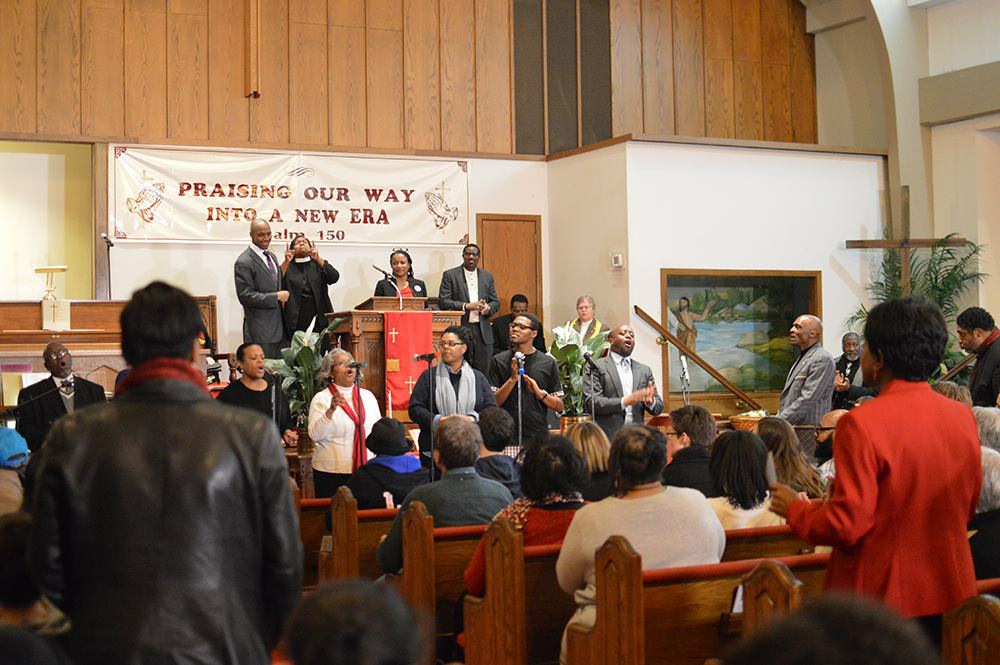
During the weekend journey with the Moral Mondays movement I reflected on how faith is the bedrock for the fight against the injustices in North Carolina. I was able to witness the intersection of faith and activism being demonstrated in the public square. The march, led by the North Carolina NAACP President Rev. Dr. William Barber, III, really began the night before at a “Religious Emphasis Service” with prayers and singing. I witnessed people from different nationalities, ethnicities, classes, and faith traditions coming together at a church to worship God in preparation for the march. It was in that space that I felt the spirits of the ancestors of various faiths who had been resilient in the fight for justice. From the prayers of the Imam, to the songs of praise and protest, it was faith that brought encouragement to the people preparing to march against the injustices in North Carolina. The next day people of various faith traditions and those who did not identify with a particular faith were marching together in unity, seeking justice for those that are oppressed. It was also the people of faith that fed, housed and encouraged us during our stay in North Carolina.
[aesop_quote background=”#507b96″ text=”#ffffff” align=”center” size=”2″ quote=”It became clear to me that faith is the engine for social movements. From the fight against the enslavement of my ancestors to the civil rights movement, faith has been the rock on which many have built their hope and fought tirelessly against the injustices in the world.” parallax=”off” direction=”left”]
As I was sitting in Martin Street Baptist Church, I began to think of all of the people in North Carolina and around the world who have relied on their faith to see them through the darkest times of their lives. I began to think of my grandmother who was a domestic worker and the daughter of sharecroppers and how she had introduced me to the church, a place where she found rest for her weary soul. It has been faith sustaining countless mothers, whom I have witnessed raise and nurture children without the basic human necessities, believing that God would make a way somehow. It was faith that sustained Mahatma Gandhi, who used his religion to push forward the Indian independence movement in British-ruled India. Faith is what Dr. Martin Luther King; Jr. called “the force behind the civil rights movement.” Even as we marched through the streets of downtown Raleigh, North Carolina, I engaged in conversations with countless individuals who heavily relied on their faith for respite and hope, and stated it as the reason they were present at the march.
The Moral March presented me with a new hope for religion. It became clear to me that faith is the engine for social movements. From the fight against the enslavement of my ancestors to the civil rights movement, faith has been the rock on which many have built their hope and fought tirelessly against the injustices in the world. So my journey as a minster continues but with a renewed passion to keep my faith at the forefront of my fight against the oppression of those on the margins of society.
I am fully persuaded that faith is to social movements as is oil is to an engine, it propels it to work. I must continue the mission that Jesus Christ mandated in the Holy Scriptures. The Moral March propelled me to rededicate myself to the mission of being a minster of the social gospel. Therefore, I have a deeper appreciation for all faith traditions, and all that they have done and are doing to free people from the bounds of oppression. The journey for justice continues, and I am eternally grateful for the Moral Monday movement because it has restored my faith in religion.