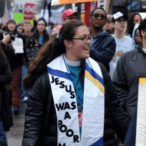
On Tuesday evening, the Poor People’s Campaign led a moral march on the Democratic Presidential debate in Des Moines, Iowa. At the invitation of local organizers, we came from every corner of the nation to demand action on the burning crisis of poverty. Today, there are 140 million poor and low-wealth people in this country, 43% of the entire population. In Iowa alone, 35% of the state, or 1.1 million people, live in poverty or deep economic precarity. And yet, since 2016, not one presidential debate has dealt with this reality and the interlocking evils of systemic racism, militarism, ecological devastation, and a distorted moral narrative that blames the poor for their miserable conditions. We arrived in the Hawkeye state resolute that the nation cannot go through another election cycle in which the lives of the poor are rejected and dismissed.
[aesop_image img=”https://kairoscenter.org/wp-content/uploads/2020/01/signal-2020-01-14-185807-6.jpeg” panorama=”off” credit=”Steve Pavey” alt=”Iowa Moral March on Debate” align=”center” lightbox=”on” captionsrc=”custom” caption=”The Poor People’s Campaign’s Moral March on the Democratic debate in Iowa earlier this week.” captionposition=”left” revealfx=”off” overlay_revealfx=”off”]
During the Des Moines debate, multiple candidates lifted up the work of the Poor People’s Campaign and last June, at our Poor People’s Moral Action Congress, the current frontrunners committed to a primetime, nationally televised debate on poverty. We are glad to see this narrative breakthrough and understand that it reflects the growing strength of our movement. And we are committed to continuing to build power. Thousands of poor and impacted people are rising up together and calling for a national debate on poverty and the centering of the moral demands of the Poor People’s Campaign in this election season and beyond.
Now, as the nation prepares for the coming primaries, we are reminded that our power as poor people and moral leaders lies in our ability to unite in the face of division and the mythmaking of pragmatic politics. These days, we are often told that there is not enough to enact our agenda. People offer small policy solutions that they claim are more realistic alternatives to our Moral Budget. But we have done the research, and we know that it makes moral and fiscal sense to invest in areas that make our country stronger: universal health care, green infrastructure and public utilities, decent and affordable housing, living wages, strong public safety nets, and tuition-free higher education.
[aesop_image img=”https://kairoscenter.org/wp-content/uploads/2020/01/signal-2020-01-14-185807-2.jpeg” panorama=”off” credit=”Steve Pavey” alt=”Iowa Moral March on Debate” align=”center” lightbox=”on” captionsrc=”custom” caption=”Poor People’s Campaign leaders, including Robert Taylor from Cancer Alley in Louisiana, place their hands on a coffin demanding ‘Everybody’s Got a Right to Live’ in Iowa.” captionposition=”left” revealfx=”off” overlay_revealfx=”off”]
We would also remind our elected leaders and those seeking office that we have continually and nearly limitlessly paid for everything from the Bush and Trump tax cuts to the largest military budget in world history. The truth is that we have an abundance of resources and a scarcity of political will. Instead of investing in the wealthy and the warmongers, we must rally around a transformative agenda that can lift up entire generations and reshape the nation around the needs of the many, not the few. What this will require is nothing less than a long-term movement that is able to develop irrefutable and independent power among the poor.
[aesop_quote type=”block” background=”#31526f” text=”#ffffff” align=”left” size=”1″ quote=”What this will require is nothing less than a long-term movement that is able to develop irrefutable and independent power among the poor.” parallax=”off” direction=”left” revealfx=”off”]
We know that the issues of the day are bigger than the dichotomy of Republican versus Democrat, or conservative versus liberal — the moral and spiritual health of this nation depends on our capacity to see deeper and more expansively. Still, although our work is not partisan, it is deeply political. Voter registration and mobilization are critical tools for advancing our strategy of shifting the moral narrative, impacting policies and elections, and building power. This strategy places the struggles and solutions of the 140 million poor and low-wealth people at the center of our political discourse.
It is no accident that the single largest potential voting bloc in American politics today are those who did not vote in the 2016 elections and that the 140 million make up the majority of non-voters. In 2016, only 45% for those making less than $15/hour voted and the number was even lower for those making a $7.25 minimum wage or less. The current system does not work for the poor and they know it.
While Democrats have championed the middle class and Republicans have racialized poverty and promoted tax cuts and corporate welfare, poor and impacted people have not heard their names or issues in American public life for at least the past 40 years. This has occurred, even as the gap between the rich and the poor has grown to levels of inequality unseen since the Great Depression.
But the poor of this country also represent the promise of an unprecedented electorate that could be a new and unsettling force not just in the coming election, but at the very heart and soul of the nation. We know that in strategic places, politicizing, organizing, and registering small percentages of poor and low-wealth people can determine elections and transform political will. We have already seen this happen in places where the Poor People’s Campaign is organized. During the recent Governor’s race in Kentucky, multiple high-poverty counties where we are active helped wrestle the governorship of the state away from another extremist. This happened even though we did not endorse a candidate or a party. Instead, many newly organized Kentuckians endorsed our agenda. This is what is possible when we build a moral fusion movement of the poor and impacted.
[aesop_image img=”https://kairoscenter.org/wp-content/uploads/2020/01/signal-2020-01-14-185807-3.jpeg” panorama=”off” credit=”Steve Pavey” alt=”Iowa Moral March on Debate” align=”center” lightbox=”on” captionsrc=”custom” caption=”The Poor People’s Campaign’s Moral March on the Democratic debate in Iowa earlier this week.” captionposition=”left” revealfx=”off” overlay_revealfx=”off”]
This is also why the Poor People’s Campaign held major events in South Carolina last week and in Iowa this week. Over the coming months, we will take sustained and escalated action to drive our agenda deeper into the national conscience, leading to the Mass Poor People’s Assembly and Moral March on Washington on June 20, 2020. Right between the presidential primaries and the party conventions, June 20 will be a significant window of time in which we can truly capture the attention of the nation and shift the moral narrative only months before the general election.
From that stage, we will transform the lyrics of the Campaign into a rallying cry for the poor of the nation: “Somebody has been hurting our people, it’s gone on far too long, and we won’t be silent anymore.”