
Few if any ideas in human history have demonstrated greater transformative power or had greater positive impact on lives and societies than the one celebrated on December 10th. When the new United Nations proclaimed on that day in 1948 that every person has at birth inherent rights that all governments are obligated to respect, protect, and fulfill, it very unintentionally unleashed a force that those in power continue to struggle to withstand, contain, and tame.
The struggle for the rest of us is, as it has always been, to adapt, strengthen and unleash that force to transform the unequal, unjust, and immoral systems that rule us. To do that we have not only to understand what gave that force such power in the past but how that power is manifesting itself in the struggles of today.
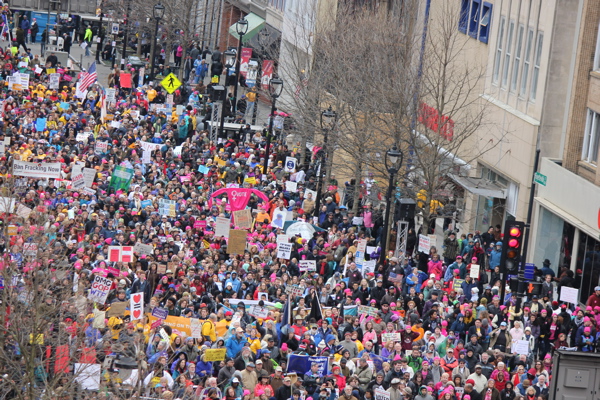
[aesop_image img=”https://kairoscenter.org/wp-content/uploads/2014/11/moral-march-crowd.jpg” credit=”Jose Vasquez” align=”center” lightbox=”on” caption=”The 2014 Moral March on Raleigh” captionposition=”left”]
Governments at first and for decades found it easy to ignore the noble words in their Universal Declaration of Human Rights. What gave those words meaning and revealed their power were acts of resistance by those to whom they most applied —those whose rights were most egregiously violated. It was the stories of people like Rosa Parks, and Martin Luther King, Victor Jara and the Mothers of the Plaza de Mayo, Oscar Romero and Sister Jean Donovan, Steve Biko and Nelson Mandela, Andrei Sakharov and Yelena Bonner, Cory Aquino and Kim Dae Jung that put a face on human rights and inspired thousands of volunteers to take part in a new and astoundingly effective non-violent global movement. Their courage came not from faith in UN documents but from something experienced deep within themselves: the rights and dignity inherent in their very being and in the being of all. This is the real source of the power of human rights.
This radical idea of universal rights became a global narrative and generated actions that helped to end dictatorships from Chile to the Philippines to Poland and to knock down literal and metaphorical walls of political, racial, and gender oppression. As the power of human rights visibly grew throughout the second half of the 20th century, both governments and non-governmental organizations responded. Seeking to maintain control of a potentially dangerous idea, governments increasingly channeled the energy of activists into an array of inter-governmental mechanisms of review, discussion, and standard setting – valuable but cumbersome, limited, and very slow. Those rights that raised questions about global economic systems were largely ignored.
[aesop_quote background=”#507b96″ text=”#ffffff” align=”center” size=”2″ quote=”As NGOs grew in wealth, size and number, human rights began to shift from a movement involving all into a career for some.” parallax=”off” direction=”left”]
NGOs, taking advantage of greater funding, sought to increase the effectiveness of volunteer activism by hiring more professionals, often with legal training. As professionals often do, they helped shape human rights into a separate specialized discipline that required expertise to fully understand and practice. As NGOs grew in wealth, size and number, human rights began to shift from a movement involving all into a career for some.
This move was accompanied by development of a kind of human rights fetishism. The phrase ‘human rights’ itself and the standards, conventions and laws built around it began to take on an almost magical power. It was as if it was enough to discover and describe the violations of rights without having to deal with the economic and political systems, interests, and power relations that caused them. This is reflected in the celebration of the core methodology known as “naming and shaming”. The idea grew, fueled by some real successes, that simply documenting and publicizing violations of UN standards can by itself cause governments to change behavior because they feel ashamed or at least fearful of harming their reputation. The additional hard work of mobilizing widespread pressure from activists, let alone building sustained mass movements, was reduced if not eliminated from ‘human rights’ work. Still, with more human rights professionals producing more documentation and getting more media attention than ever before and with the end of the Cold War, the advance of human rights by the end of the 1980s began to seem unstoppable.
The 1990s shattered that illusion in the most horrific ways possible. The governments supposedly most committed to human rights were not ashamed to stand by as more than 600,000 people were slaughtered in Rwanda. Nor were they shamed into taking action to protect thousands being massacred in the UN safe haven of Srebrenica. These indescribable horrors, and others, painfully revealed the limits of shame and how easily governments, in the absence of sustained pressure, could disregard their commitments to human rights when these were costly or did not serve other national interests.
[aesop_image img=”https://kairoscenter.org/wp-content/uploads/2014/12/15676446192_24fd8ae101_b.jpg” credit=”Earchiel Johnson/People’s World” align=”center” lightbox=”on” caption=”Ferguson October” captionposition=”left”]
In the 2000s it got worse. The horrific attacks on the NY World Trade Center in 2001 opened up, with considerable public support, the not-very-new moral rationalization for violating rights in the name of combating terror, allowing the United States to openly carry out and justify detention without trial, disappearances, and torture. The inability to stop the United States from torturing people or bring to justice anyone who has carried it out has been one of the greatest blows to the idea of human rights and one of the darkest failures of the human rights movement. The global economic crisis of 2008 has drawn attention to dramatic increases in poverty and record levels of inequality but also demonstrated once again how little governments like the US, (where UNICEF has just reported 1 out of every 3 children are poor), take seriously economic and social human rights. Human rights hardly if ever appears in the public discourse on the continuing crisis.
It is true that human rights organizations are more numerous, have more resources, and operate in more countries than ever before. No one can or should deny that these groups continue to play an important and valuable role in stopping violations or advancing human rights policies in many countries. The work of developing and, even more importantly, defending human rights norms and documenting violations will remain important.
It is just clearly not enough. It is impossible to look at what is happening in places like Syria, Egypt, Sri Lanka, Zimbabwe, Gaza, Russia, China, the United States and so many others and deny that human rights have been losing ground. It is impossible to deny that the idea of human rights is in crisis.
[aesop_quote background=”#507b96″ text=”#ffffff” align=”center” size=”2″ quote=”There have been aborted uprisings and crushing defeats but there have also been stirring victories. And there have been no signs that the struggle for new and better ways to move forward is slowing down.” parallax=”off” direction=”left”]
It is the crisis that offers hope. For when old ways of thinking and acting no longer work to advance the deepest desires of the human spirit, people struggle to find new and more powerful ways to keep fighting. That is what we have been seeing —- in the Occupy movement, in the Arab Spring, in landless movements in India and Brazil, in struggles for democracy in Ukraine and Hong Kong, in the Moral Mondays movement and the sustained and bold demonstrations of outrage taking place as this is written in the streets of Ferguson, New York, Cleveland, and across the country.
These movements and awakenings have exposed and mobilized powerful economic, political, and social forces deeply opposed to change and prepared to do whatever they must to stop it. There have been aborted uprisings and crushing defeats but there have also been stirring victories. And there have been no signs that the struggle for new and better ways to move forward is slowing down.
These are not what those who feel they are in charge of labels would call human rights organizations, movements or battles. They are, however, all fights for human rights. And they bring what has been missing far too much and for far too long from those who do wear the human rights label: the leadership of those most directly affected, in particular young people, from all walks of life; a refusal to separate moral vision and spiritual values from explicit political objectives; a growing understanding that the oppression experienced is not the result of a few individuals or bad policies but local, national, and global systems set up to benefit and enrich a tiny minority; and a spirit of resistance, often expressed in old and new song, that like the genuine spirit of human rights comes out of the deepest part of our very beings.
Those in the streets do not need tutorials on human rights standards. They do need help in documenting and publicizing the violations of those standards. They do need help in understanding better the long history of the fight for human rights. And they most importantly need support in holding on to human rights values even in the face of violent repression.
The best way to celebrate Human Rights Day in 2014 is to join, support and fight for the new human rights movement that is still being born!