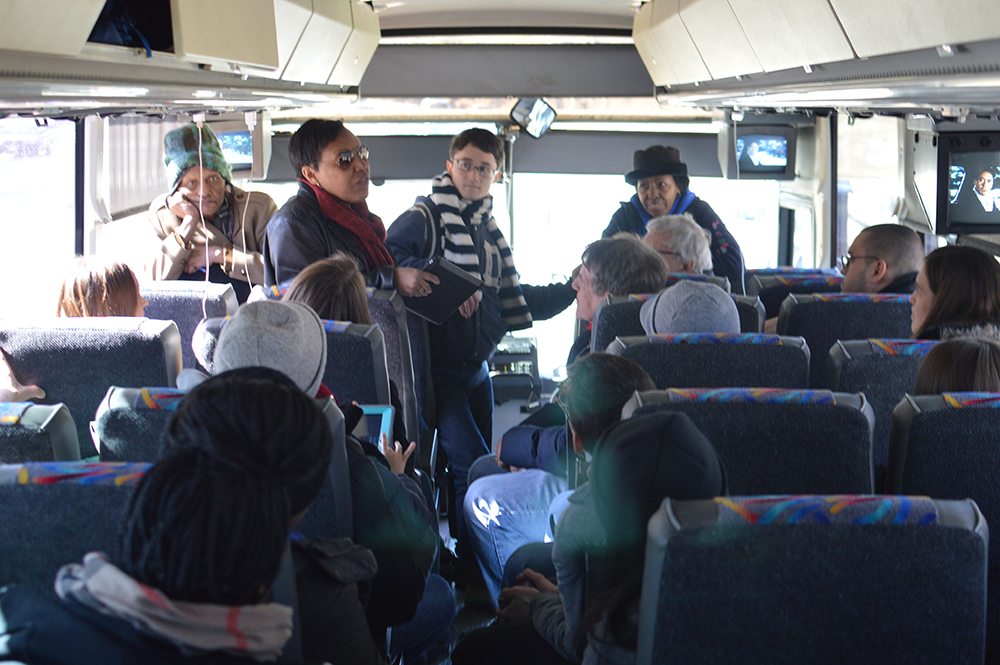
This reflection was written in response to the Winter 2015 immersion course during which we traveled to North Carolina to join the Historic Thousands on Jones Street Moral March and learn from the North Carolina NAACP and the Forward Together Movement.
This Immersion helped me to see more clearly what should be the role of the Church in social transformation. After the Civil Rights Movement of the 1950s and 60s, there evolved a historical root of inaction; particularly in the Black church. Frankly, the Black church has lost its Prophetic voice.
[aesop_image imgwidth=”40%” img=”https://kairoscenter.org/wp-content/uploads/2015/03/Downtown-Raliegh.jpg” align=”left” lightbox=”on” captionposition=”left”]
As I listened to Dr. Barber’s lecture/sermon on Saturday afternoon, I keep thinking of the following quote by Rabbi Abraham Joshua Heschel: “Yet the purpose of prophecy is to conquer callousness, to change the inner man as well as to revolutionize history.” In a sermon delivered in Chicago circa 1967, Dr. King opened with these words: “Centuries ago the Prophet Jeremiah raised a question, ‘Is there no balm in Gilead? Is there no physician?’ He raised it because he saw the good people suffering so often and the evil people prospering.”
The Moral Mondays Movement is a 21st Century response to Jeremiah’s question. Unfortunately, we have far too many churches who are suffering from spiritual laryngitis. The lost voice of the Black church in particular. It is impossible to be concerned pastorally about the congregants which one pastors and not be concerned about the policies and the decisions that impact their daily lives; not be concerned about the public square. Far to often, clergy and laity have taken the Jesus’ words in Luke 4:18 as kind of private salvation, which of course is the opposite of what Jesus meant. The focus of Moral Mondays’ Fusion Politics is rather than everybody working on their own individual issues, we all come together at the state level, from the bottom up. The theology is that fusion will bring the people together, this is what upsets extremists, because they know that when the masses wake up and come together, extremism is pushed to the margins.
[aesop_image imgwidth=”40%” img=”https://kairoscenter.org/wp-content/uploads/2015/03/Moral-Monday-March.jpg” align=”left” lightbox=”on” captionposition=”left”]
In the past few months of my involvement with both the Black Lives Matter and Moral Monday Movements, I have embraced my personal calling out to take action. We each have Kairos moments that draw us out. King did not go to Montgomery to be the leader of the Civil Rights Movement but the moment, Rosa Parks’ actions, thrust upon him the call to be both a preacher in the church and a preacher in the public square; and he challenged his members likewise, he never stopped being a pastor.
In seminaries we are trained to do that which is priestly and pastoral but we are thrust into that third essential area of ministry, which is being prophetic. The leaders of the prophetic tradition have shown us time and time again, that we need the first two in order to properly address the third. It is a matter of protest as bearing witness. This requires that each of us 1) know who we are before we enter the public square, 2) enter the public square to bear prophetic witness, and 3) be intentional about changing the winds of the time.
[aesop_image imgwidth=”40%” img=”https://kairoscenter.org/wp-content/uploads/2015/03/UCC-Hospitality.jpg” align=”left” lightbox=”on” caption=”Hospitality from the Community UCC in Raleigh, NC. ” captionposition=”left”]
We are commanded to register our discontent. Registering our discontent means more than sending a tweet, or posting on Facebook. We must always have a public witness. The Prophetic Biblical witness sets the example for us: Moses had to go to the Pharaoh, and say let my people go. (Exodus 9:1) Jeremiah, Chapter 22 says go down to the place and tell the king that in the place, in this seat of government, there is not supposed to be oppression, and killing of the innocent, and hurting of the children.
The Moral Mondays Movement is a response to the cries of our brothers and sisters, a response to the poor, a response to how we treat the least of these and those issues that must be moved from margins of public debate to the very center of our moral and ethical consciousness.