
This piece was co-authored by Aaron Scott and The Rev. Sarah Monroe (Chaplains on the Harbor) and The Rev. Lindsey Krinks (Open Table Nashville, Inc.). It originally appeared at Aaron’s blog, and his re-published here with his permission. It’s a reflection on a tour of the Pacific Northwest that the three went on, meeting with different communities of poor people in struggle throughout the region.
The opinions expressed here aren’t necessarily those of the Kairos Center or its staff.
The Rev. Dr. Martin Luther King, Jr. called for a “nonviolent army of the poor” in the last campaign of his life, the 1968 Poor People’s Campaign. Willie Baptist, founder of the Kairos Center/Poverty Initiative, frequently takes this call to the next level by saying, “Every army needs generals.” Chaplains on the Harbor recently returned from a week on the road with a cohort of our fellow street pastors, grassroots organizers, and movement builders. Through our conversations and information gathering along the way, we reached a point of clarity regarding our own role in King’s and Baptist’s assessment: just as every army needs generals, every army also needs chaplains. We do not define “chaplain” here in the terms narrowly set by institutions invested in enforcing the status quo, but rather by those in our movement who are getting the job done. What is the role of chaplaincy in social movement building, in resurrecting a new Poor People’s Campaign for today? Five key responsibilities emerged over the course of our time together:
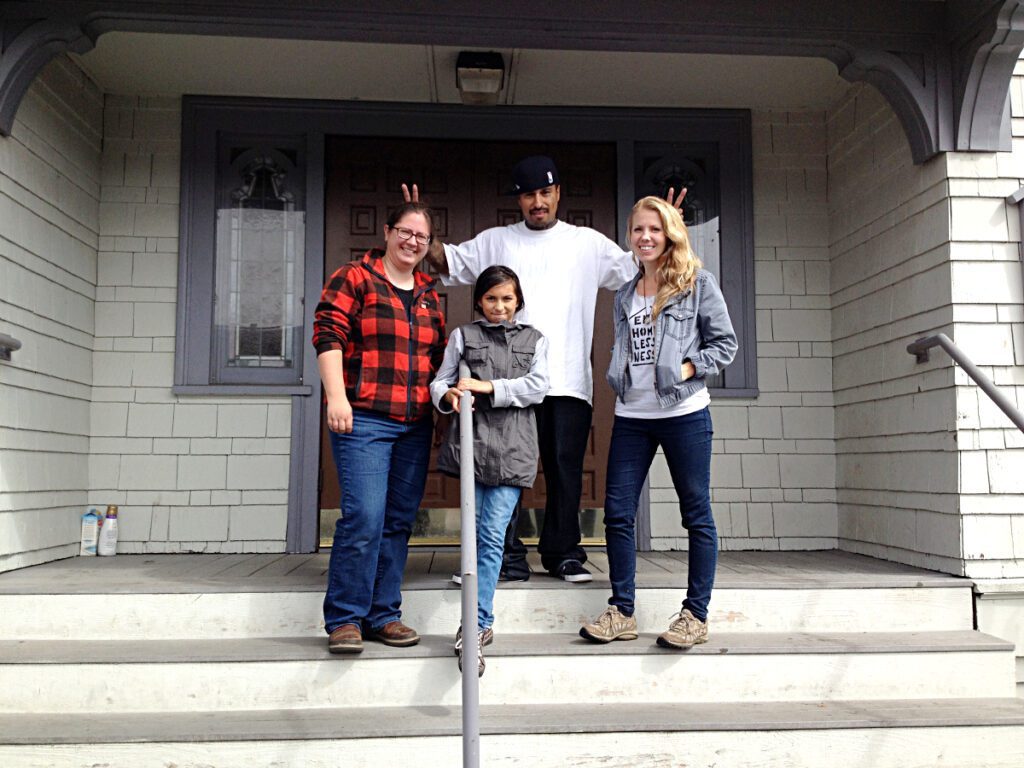
1) Pastoral care for the front lines of struggle: Radical chaplaincy first and foremost includes our accompaniment and endurance alongside grassroots freedom fighters—on the streets, at protests, in tent cities, in jail, at ground-zero sites of climate change and in other crisis zones. Our friend Neaners, a leader at Tierra Nueva in rural Skagit County WA, shared some powerful stories of his work in relation to this model of chaplaincy. Neaners spent five years in solitary confinement, building strong relationships with Tierra Nueva pastors during his incarceration through letters and phone calls from the jail where he was held. Upon his release, Neaners went to work with Tierra Nueva’s gang outreach project. A former gang leader himself, Neaners has true skill in connecting with gang-involved youth. His theological insights into the systemic injustice of poverty, in the midst of God’s abundant creation, are at once grounded and complex, and he communicates these in a way that speaks urgently and relevantly to others struggling for survival and dignity. Neaners is one of the million unsung saints out there on the ground, who has both the personal experience and the dedication to others’ liberation that makes this movement possible.
[aesop_image img=”https://kairoscenter.org/wp-content/uploads/2015/10/1.jpg” alt=”Radical Chaplaincy” align=”center” lightbox=”on” caption=”Rev. Sarah, Adelita, Neaners, and Rev. Lindsey in Aberdeen, WA” captionposition=”left”]
2) Building the theological, spiritual, and moral framework of our struggle for human dignity: As chaplains of this burgeoning force, it is our duty to prioritize the moral authority of the poor in the movement to end poverty. We are not called to clean up, make respectable, or dilute the message of grassroots leaders. We are simply called to amplify the message in these leaders’ own words, on their own terms. We can amplify this message through a range of tactics. At Chaplains on the Harbor in rural Grays Harbor County, WA, we work to bring the urgent message of our tent city constituents to the forefront of the institutional church. This includes hitting the preaching circuit during our organizing campaigns, inviting church groups out to learn from our leaders on the ground, and supporting these leaders in directly engaging the highest levels of institutional church power. In mobilizing community support as they sought out a second host site for Rivercity, our tent city constituents asked that Bishop Greg Rickel of The Episcopal Diocese of Olympia pay them a visit to begin building a relationship with him as well as help boost their visibility. Bishop Rickel not only showed up, but also spent time interviewing camp leaders and helping out with our social media campaign. In strategically leveraging the bishop’s position of moral authority, camp residents were able to assert their own authority to a wider audience in their struggle for survival and dignity.
[aesop_image img=”https://kairoscenter.org/wp-content/uploads/2015/10/2.jpg” alt=”Radical Chaplaincy” align=”center” lightbox=”on” caption=”Bishop Rickel at Rivercity, Aberdeen, WA” captionposition=”left”]
3) Equipping and supporting grassroots leaders to love and protect one another: As we labor for a new and radically transformed society where the rights and needs of all people are defended, we also share the responsibility of caring for one another in the harsh reality of the present. As poverty-abolitionist chaplains, we have the particular task of teaching and encouraging our communities how to lean toward care and respect for one another in the midst of repression and hardship. This includes restoring justice and righting wrongs where trust has been broken internally in our movement. We toured Dignity Village, Inc., a self-governing homeless settlement in Portland, OR where leaders demonstrated a powerful model for this on several levels. Village members share the task of staffing 24-hour internal security for the site. They also collectively sustain themselves by selling firewood and scrap metal, a level of self-sufficiency in which they take much pride. Village members take seriously their responsibility to defend one another: our tour guide Lisa explained the village’s process of ejecting residents who practice abuse or sexual harassment against other community members—as well as the opportunity residents find at Dignity Village to heal from personal trauma and the trauma of living on the streets. These small-scale projects of survival and dignity are icons of integrity to which our entire movement looks for hope and healing.
[aesop_image img=”https://kairoscenter.org/wp-content/uploads/2015/10/3.jpg” alt=”Radical Chaplaincy” align=”center” lightbox=”on” caption=”Rev. Sarah, Lisa, Aaron, and Rev. Lindsey at Dignity Village, Portland, OR” captionposition=”left”]
Sisters of the Road, a collective cafe in Portland, OR serving unhoused people, also offered a powerful example in this task of loving and protecting one another in the movement to end poverty. In addition to their model of radically dignified hospitality, Sisters also leads liberation-based education with their people on the streets. A white, unhoused Sisters’ worker explained to us that this education tackles systemic issues “like racism, which can be hard to swallow at first if you’ve lived on the street—you’re like, ‘What do you mean I have privilege?’ But they show you in a way that makes sense in your own life, because it’s about the whole system.” In order to truly love and protect one another, radical chaplaincy must include this kind of systemic analysis of forces like racism that have pitted the poor against one another and sabotaged our ability to stand together. We study history and we employ systemic analyses because we love each other and do not want to fall into the traps that have been laid for us for generations.
4) Nurturing our people to keep their eyes on the horizon: Radical chaplains must spiritually guide the multitude of leaders of this movement to find their individual purpose, strength, and hope in the long-term struggle for collective liberation. To do this, we have to stay in touch with leaders across many borders and lines of difference who are working toward our common goal. In meeting Lindsey, the street pastor at Open Table Nashville, Inc., we at Chaplains on the Harbor were struck by the resonance her story had with our own. Both of our organizations are working to support self-governing tent encampments in our local areas while navigating a web of police, legal battles, media relations, leadership conflicts and, most fundamentally, the large-scale economic and political forces driving policies of displacement. Despite being across the nation, in different states, and organizing in very different contexts (Nashville is a major city while Aberdeen has a population of 17,000 people), we shared a clear understanding that our people were suffering in the same ways as a result of the same systemic injustices—as well as a clear understanding that our best chances at victory were bound up with each other’s success.
In the same vein, we spent an evening meeting with Portland Committee for Human Rights in the Philippines. We were blessed by the radical analysis and depth of solidarity these young Filipin@ organizers extended to us as we took turns describing what our struggles had in common. PCHRP members shared stories of families torn apart by forced economic migration, of indigenous repression, and of the recent murder of a young Filipina trans woman at the hands of a U.S. Marine. We at Chaplains on the Harbor shared our stories of homeless parents separated from their children by CPS, police brutality against Native people, and our uphill effort to create safe spaces for women living on the streets. After a long period of listening, Agustín, a PCHRP member, said, “I think a lot of this comes down to the issue of human trafficking. CPS separating families and placing children into foster care at these rates is trafficking. The prison system is trafficking. Families torn apart because of poverty is trafficking.” We were deeply moved by the immediacy with which PCHRP moved to connect our issues—as a majority white, rural, stateside organization—to their own transnational struggle. It has inspired us to keep lifting our gaze to see the big picture and the many, many lives connected to our local resistance work.
[aesop_image img=”https://kairoscenter.org/wp-content/uploads/2015/10/4.jpg” alt=”Radical Chaplaincy” align=”center” lightbox=”on” caption=”Drew, Agustin, Nikki, and Trisha of PCHRP with Aaron and Rev. Sarah, Portland OR” captionposition=”left”]
5) Building power and taking power: King said, “Power without love is reckless and abusive, and love without power is sentimental and anemic.” The Coup said, “Preacher man wanna save my soul, don’t nobody wanna save my life.” We are not truly grounded in the love of God’s children if we fail to build the power necessary to defend the lives of God’s children. There are countless creative ways to build power for the sake of this movement. Right 2 Dream Too, Portland, OR’s self-governing urban rest station and encampment, showed us a few. First, unhoused community leaders took over an abandoned downtown lot (some of the city’s most expensive real estate) and held it for four years. Second, those leaders have used the land to organize a safe sleeping space for other unhoused people and run it with a level of efficiency and integrity that puts the city’s own efforts to shame. The power of R2DToo’s work has won support in all sectors of society, from elected officials to religious leaders—and even police, who have noted that R2DToo’s presence on the block has increased neighborhood safety more than anything that came before it. Their model is an incredible synthesis of power and love, leveraged with the long-term vision of how we might build a new society free from poverty and homelessness.
[aesop_image img=”https://kairoscenter.org/wp-content/uploads/2015/10/5.jpg” alt=”Radical Chaplaincy” align=”center” lightbox=”on” caption=”Rev. Lindsey, Mike of R2DToo, and Rev. Sarah in Portland OR” captionposition=”left”]
The historical roots of chaplaincy date back to Tours, France in the 4th Century CE just after Constantine made Christianity the religion of the Roman Empire. Late one night, a young soldier named Martin was riding to his base on horseback and came across a poor man who was freezing outside the city gates. With nothing in his purse to offer, Martin cut his military cloak in two and wrapped one half around the freezing man, keeping the other for himself. Martin returned to the military base and that night as he slept, he saw a vision of Jesus wrapped in the cloak. In his vision, Jesus said, “Here is Martin, a soldier who is not even baptized, and he has clad me.” Martin was so moved by this experience that he told everyone about it, was baptized, and later left the military. As time passed, the remaining half of his cloak became a holy relic and was taken into battle as a symbol of God’s presence. The cloak, or cappa in Latin, was kept in a capella and the guardian who traveled with the cloak was called a capellanus. The English words “chapel” and “chaplain” originate herein and Martin is now known as St. Martin of Tours.
The history of chaplaincy and St. Martin’s cloak are contested narratives that shed light on the way that Empire uses the symbols of the church and the bodies of the poor to legitimize and carry out violence, oppression, and colonization. To take chaplaincy back to its roots, then, is to journey outside the city gates and to bear witness to St. Martin’s radical act of mercy and solidarity and Jesus’ identification with the poor. The kind of street chaplaincy we are interested in reclaims and resurrects this narrative. Rather than using it to bolster institutional power, we are interested in bolstering the growing movement of people on the margins who, like the freezing man, have been cast out and are struggling for dignity and basic human rights. Through our work of mercy and presence, we stand in the shadows of empire with those who too often shiver and suffer in silence. Through solidarity and accompaniment, we move forward together with amplified voices, burgeoning power, and the deep understanding that Christ is present and struggles alongside us. And we are transformed.