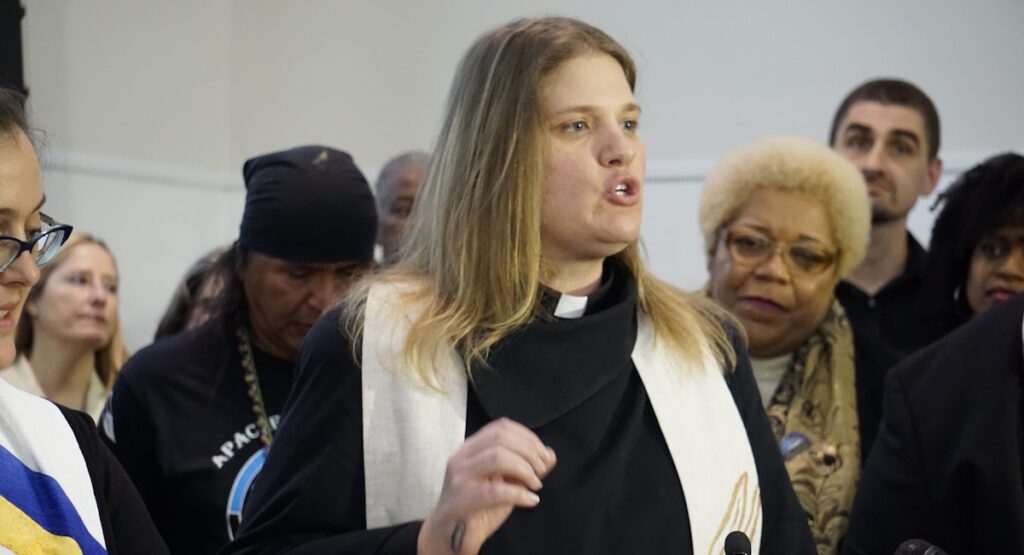

Rev. Shawna Foster is a member of About Face: Veterans Against the War and serves on the National Steering Committee of the Poor People’s Campaign: A National Call for Moral Revival. As a Nuclear Biological Chemical Specialist in the National Guard, she refused deployment in 2006 when she realized there were no weapons of mass destruction in Iraq and that the Bush Administration lied about it. She cares deeply about poverty and the military as she was raised on WIC and food stamps despite her father being enlisted full time in the Air Force.
Currently she is a minister serving Two Rivers Unitarian Universalist. Today she fights against war as it creates poverty in the United States and overseas. Her continued work highlights the contradictions of being a service member today — that while many veterans do not receive full benefits as promised, die by suicide while struggling to get adequate healthcare, and have to receive additional government services such as food stamps — private corporations continue to receive contracts that cost hundreds of billions of dollars. After the U.S. has mainly borrowed 5 trillion dollars to spend on the longest wars in U.S. history, how can we afford to offer veterans and the poor a way out of poverty?
This interview with Rev. Foster was conducted as part of The Souls of Poor Folk Audit of the Poor People’s Campaign: A National Call for Moral Revival. Thanks to the Institute for Policy Studies for their work on the Audit and their help putting this interview together!
How did you originally get involved in the veterans movement?
 Rev. Shawna Foster: I joined the Nebraska Army National Guard as a nuclear biological chemical specialist in 2003. I come from a poor family and out of all the armed services, only the Nebraska Army National Guard promised to pay full tuition. As time went on, my deployment kept on getting delayed, and it was very confusing. And so I moved on with my life; I got pregnant and I got married. Immediately, members of my unit started harassing me, saying I was worthless and if we got deployed, they would kill me first. Initially I tried to deal with it directly in the unit, but it wasn’t working out.
Then I read this book by Thomas Ricks called Fiasco, which said that there were no weapons of mass destruction and the Bush administration knew it. I thought to myself, “what on earth am I in this unit for?” Shortly after, we received orders to change our MOS (military occupational speciality) from weapons of mass destruction to truck driving. At that point I thought to myself that this war is full of shit, and that I’m not going to die for an administration that lied to me. I started to research how to properly exit the military, and Iraq Veterans Against the War (IVAW) came up. They offered to provide me with legal aid, and said they’d be ready to fight for me if any issues came up. Four years later IVAW asked if I wanted to be a part of their women’s committee. Things took off from there. Not only did I serve on the women’s committee, but I was on the board, and I participated in The Right to Heal Tour. I was the board chair for the last two years.
Can you tell us about the name change from Iraq Veterans Against the War to About Face: Veterans Against the War?
In order to join IVAW you had to be a post 9/11 veteran, and you had to believe in three things: to end the war in Iraq and Afghanistan, to heal the troops, and to pay reparations to the people of Iraq and Afghanistan. Those demands were chosen because of what soldiers were experiencing overseas. Soldiers were having their combat pay slashed and they didn’t have the proper equipment when they were over-deployed. When they came home, they didn’t have the medical treatment that they were promised. At that time the waiting list for the VA was around 3 years, and a lot of people were dying by suicide. Veterans were killing themselves at a rate of 5 to 1, so for every one person that was actually killed in combat, five people were dying by suicide. Frankly, it was a lot cheaper for the government to have a soldier die by suicide than to fund a soldier’s healthcare. It saves the government money for the VA to be inefficient.
[aesop_quote type=”block” background=”#31526f” text=”#ffffff” align=”left” size=”1″ quote=”Frankly, it was a lot cheaper for the government to have a soldier die by suicide than to fund a soldier’s healthcare. It saves the government money for the VA to be inefficient.” parallax=”off” direction=”left” revealfx=”off”]
At the same time, we were also watching our jobs being taken away by contractors. Contractors hired by companies like Blackwater were sent overseas to do the same exact job we were paid to do. But Blackwater mercenaries were making $90,000–$120,000 a year, much more than American soldiers, so soldiers would finish their duty and come back as a contractor. The issue is if you die as a contractor doing the same job, you don’t get the same benefits for life that you do in the military. You’re making $90,000 a year but you’re not getting any tuition assistance, your family doesn’t get any bereavement, and they don’t pay any of your housing. Contract work is also how they conceal the total amount of troops killed overseas. If you die as a contractor and you are a veteran, nobody cares, nobody is throwing a parade, nobody is remembering you anywhere, nobody is naming a street after you. But if you die in the service, well that is totally different. You come back in a coffin with a flag draped over you. This is one of the ways the war machine has been able to continue at our expense, against the public’s support, without generating the same resistance that existed during Vietnam. The anti-war movement before was always about troop death tolls.
Contractors are also there to provide security for resource extraction. Similar to the rise of terrorist groups that are stateless, multinational companies are not beholden to any country. They are not beholden to the Geneva Conventions. Whether its securing oil, mines, or some other resources, they simply work to keep the economy going. The privatization of the military made us realize that even if we as U.S. soldiers won reparations, the wars would continue under a mercenary society.
[aesop_quote type=”block” background=”#31526f” text=”#ffffff” align=”left” size=”1″ quote=”The privatization of the military made us realize that even if we as U.S. soldiers won reparations, the wars would continue under a mercenary society.” parallax=”off” direction=”left” revealfx=”off”]
This prompted us to think about our mission and militarism more broadly. We were inspired by Rev. Dr. Martin Luther King Jr.’s 1967 speech Beyond Vietnam. He pinpointed that it wasn’t just the military industrial complex that Eisenhower had warned us about, it was a process of militarism. The fact that weapons which had been used in Iraq were being sold to cities like Ferguson and being used against civilians indicates how this is taking shape today. It blew my mind to watch the Ferguson tapes and to see police point guns directly at people. We were trained in the military that you don’t point a gun at somebody unless you are shooting them, because when you are occupying a territory you are trying to build positive relations with people on the ground. You don’t want to scare people or piss them off by threatening them, but that was what the Ferguson police were doing. They were occupying the city in ways that were even worse than the military’s tactics.
[aesop_quote type=”block” background=”#31526f” text=”#ffffff” align=”left” size=”1″ quote=”It wasn’t just the military industrial complex that Eisenhower had warned us about, it was a process of militarism. The fact that weapons which had been used in Iraq were being sold to cities like Ferguson and being used against civilians indicates how this is taking shape today.” parallax=”off” direction=”left” revealfx=”off”]
We saw the police being militarized just as we saw schools being militarized, along with the creation of a school-to-prison pipeline. In many places schools are underfunded, but the ROTC would be there, which helps create a backdoor draft. We saw more and more gated communities hiring private security companies and more cities funding anti-homelessness through private security companies. Buildings were militarized by putting down spikes so that homeless people couldn’t sleep. In a society where violence is an acceptable answer to any problem, the process of militarization can occur through any issue. So IVAW decided that soldiers — the people who agreed to die and to kill others — had to be the ones to speak out against violence overseas and at home.
That is why we began to emphasize militarism, and so we also changed our name from IVAW to “About Face,” which is a military marching term for when you turn 180 degrees and immediately go the other direction. That is what we really need to do with our military as our country marches towards a privatized, militarized, mercenary society at all levels of our institutions.
[aesop_quote type=”block” background=”#31526f” text=”#ffffff” align=”left” size=”1″ quote=”"About Face" … is a military marching term for when you turn 180 degrees and immediately go the other direction. That is what we really need to do with our military as our country marches towards a privatized, militarized, mercenary society at all levels of our institutions.” parallax=”off” direction=”left” revealfx=”off”]
Can you talk about the military-industrial complex and its relationship to militarism?
To understand this relationship, you need to understand how both are justified. Traditionally, the military industrial complex is justified in two ways. The first justification is that the country needs security. In order to defend itself, the country needs a standing army that will be ready to respond first. The second justification is that spending money on the military stimulates the economy. There is a revised history that World War II simply turned our economy around. Both of these are untrue.
One of the things we did after World War II compared to World War I was emphasize social investment in Europe. Instead of punishing countries like Germany with economic sanctions, through the Marshall Plan we rebuilt Europe, which made it a place less susceptible to bigotry and genocide. That is what brought us peace and prosperity, but we haven’t followed that strategy since World War II. We didn’t rebuild Vietnam. We are not building up Afghanistan or Iraq, so we have not really made a dent in terrorism. The destabilization of Iraq in 2003 brought about something worse than the Taliban. It’s the same thing with Afghanistan. If you look at the history of these nations, before we decided to invade them, we were involved in CIA activity to influence regime change. Osama Bin Laden was trained by the CIA to fight the Russians. We funded his army and he learned how to fight from us. We created many of these enemies and so we return to fight again, but we never actually engage in nation building. This is because the military industrial complex’s first goal is not peace or security. Its first goal is profit. It’s not going to invest in things like nation building, it is going to invest in bigger and more sophisticated weapons. So the idea that the military industrial complex guarantees security is false.
[aesop_image img=”https://kairoscenter.org/wp-content/uploads/2018/05/ShawnaMayPPC.png” panorama=”off” alt=”Rev. Shawna Foster” align=”center” lightbox=”on” caption=”Rev. Shawna Foster with Unitarian Universalist Association President Rev. Susan Frederick-Gray, Rev. James Forbes, and Rev. Abhi Janamanchi at the first day of action for the Poor People’s Campaign’s 40 Days of Moral Action in Washington, D.C. (May 14, 2018).” captionposition=”left” revealfx=”off” overlay_revealfx=”off”]
It’s also false that the military industrial complex guarantees economic prosperity. If you go to Brown University’s Public Policy webpage, they have this resource called the “Costs of War,” which demonstrates how much war has cost us, and how that money could have been better spent instead. For example, if you spent 230 billion dollars in war, it creates 1.6 million jobs. But if you spend 230 billion dollars in healthcare, that creates 3.2 million jobs. So, investing in war is a losing investment. This is why the peace and prosperity we had after World War II was actually from the social programs we invested in in this country and in Europe. It’s true that there were changes to our economy under World War II, such that women were allowed to work in more industries, which expanded the workforce. But that wasn’t due to spending on the bombs themselves.
While that is the military industrial complex, militarism justifies the idea that violence is an acceptable answer to any problem. So when you have kids in school showing problematic behavior — especially kids of color and poor kids — the answer is to lock down the school, put a fence around it, and install metal detectors. Because of the inherent racism in our society, black students are being profiled for violence, while white students who commit crimes are treated differently. Militarism’s response is to send those kids to jail. But kids don’t need jail. They need support. They need counseling. They need investment and they need other economic opportunities besides the military.
[aesop_quote type=”block” background=”#31526f” text=”#ffffff” align=”left” size=”1″ quote=”Militarism justifies the idea that violence is an acceptable answer to any problem.” parallax=”off” direction=”left” revealfx=”off”]
We also see militarization in neighborhoods. Even though the violent crime rate — and crime overall — has decreased, our police forces are increasingly responding to everyday problems with violence. Police are trained to think as military officers under threat. More so, what we saw at Standing Rock was the National Guard, the local police force, and private security companies all working together, so you are seeing the integration of mercenaries into our own society just like you saw overseas. More contractors are being hired to do the jobs we were supposed to do, and more private security companies are being hired to keep our communities “safe” instead of a community-controlled and publicly accountable police force.
These responses are only reasonable if we accept that people are basically worthless to society and that there is no point in public investment anymore. This is how militarism is also connected to racism. When the population was 90 percent white, public investment generally was thought of as a great idea, but now that most of the population is not going to be majority white anymore, more people reject any sort of public investment. As we saw in Ferguson, a lack of public investment fosters militarism. A majority white police force occupied a city for their parking fees, because public funding had been purposely decimated. This encouraged police to constantly harass its own constituency.
[aesop_quote type=”block” background=”#31526f” text=”#ffffff” align=”left” size=”1″ quote=”These responses are only reasonable if we accept that people are basically worthless to society and that there is no point in public investment anymore. This is how militarism is also connected to racism.” parallax=”off” direction=”left” revealfx=”off”]
What do you see as the first steps toward a solution to these deeply embedded issues?
When talking about solutions, we need to first be careful that we do not promote nativism. We have a moral responsibility to the countries we decimated, and so any solution we advance needs to include reparations. We killed 1.2 million people in Iraq and Afghanistan and created 10 million refugees; people overseas deserve our money to rebuild their economy.
We also need to invest in social infrastructure at home. Whitney Young, the director of the Urban League during the 1960s, talked about how we needed a Marshall Plan for America because African Americans are just like the decimated Germans and Europeans after WWII. Many of the social policies passed in the 1960s were inspired by the Marshall Plan. And social investment is also more cost-effective for the country as a whole. It’s cheaper to educate kids then to incarcerate them. It’s cheaper to give the homeless a home instead of having a constant police force harassing them. It’s cheaper to give people healthcare than it is to see them through emergency room visits. It’s so much cheaper to invest in immigrants, because they play an important role in our economy. Public money that goes towards private investment for the few should be redistributed as social investment for the many. But those in power don’t care if it’s more expensive to jail people, to deny them healthcare, or to keep them undocumented, because it’s not cheaper for them. They have no incentive to care about us. For the wealthiest segment of our society, it’s in their interests to make cutbacks rather than to make public investments.
[aesop_quote type=”block” background=”#31526f” text=”#ffffff” align=”left” size=”1″ quote=”Those in power don’t care if it’s more expensive to jail people, to deny them healthcare, or to keep them undocumented, because it’s not cheaper for them. They have no incentive to care about us.” parallax=”off” direction=”left” revealfx=”off”]
In terms of war, I am ideologically different than the pro-peace movement during the Vietnam era. I am not a pacifist. I believe in deescalation. I believe in multinational efforts like what the UN has tried to do. I don’t believe in just laying down weapons everywhere, all the time. I do believe in multinational cooperative agreements and I do believe in a publicly owned military where their mission really is diplomacy first. And I believe we should never privatize the military, because war is never a tool for profit. No company or organization should be able to make a profit off of killing other people. That is always morally wrong. It should cost us financially and it should cost the public to be able to wage war.
What are some of the issues that women face in the military?
Women, especially trans women, experience extremely high rates of sexual assault in the military. When I was working on the women’s committee, 1 in 3 women were sexually assaulted. I’ve heard stories and read cases about women who were deployed in a forward operating base, and who were accused of causing problems for men there. As a solution the men would rape them in order to get them pregnant, because you couldn’t be pregnant in a deployed zone. At the time, women’s healthcare services — such as readily available birth control — were unavailable on foreign operating bases. So sexual assault in the military is a major issue.
Yet fighting for women’s rights and LGBTQ rights in the military can be problematic because of the nature of the military itself. I don’t like using the military to push a progressive agenda because the military is made to kill people. Groups that push to make the military more inclusive can easily gloss over that fact.
From my own experience, I came back two weeks after I had my baby, but never missed a drill the whole time I was pregnant. When I went back, I brought my breast pump with me. One time when we were out on maneuvers and we were standing around waiting for orders, I decided it was a good time to go pump. As I left one of the guys followed me. He went back to everybody else and told them what I was doing in the field, and they all said that I was totally worthless because I was pumping. Then, in that guard unit, they went for their two week drill and I didn’t go because I just had a baby. They all talked about how worthless I was and that they were going to kill me when we went overseas. When I heard about this I went directly to my First Sergeant and I said, “Is this true?” He brought in the people who said it and they said, “We were just joking around, we apologize.” Because I jumped over the chain and didn’t go directly to them, they hated me even more. Still, I was committed to going overseas because I had a personal vendetta to prove these people wrong about women. It was only when I read Thomas Ricks’ book that I started to question what I was doing.
There are plenty of other women who have far more horrific things to share about being in the military as women or as transgender people. Still, when the military is used to advocate for women’s rights or LGBTQ rights, I think to myself as an oppressed gender minority: “Fuck that! Fuck using the military to fight for women’s rights; they want us to die. That’s why they’re letting us serve.”
[aesop_quote type=”block” background=”#31526f” text=”#ffffff” align=”left” size=”1″ quote=”I don’t like using the military to push a progressive agenda because the military is made to kill people. Groups that push to make the military more inclusive can easily gloss over that fact.” parallax=”off” direction=”left” revealfx=”off”]
What are the political forces that are stopping the changes you would like to see, and instead promoting militarism?
We definitely need campaign finance reform. The top ten contractors to the military spend around $30 million on lobbying. Together, these contractors receive hundreds of billions of dollars a year from the government. This year they’re passing a $700 billion Department of Defense budget, and I believe 54% of that goes to private contractors. This sets up a system where if they bring in $300 billion dollars it’s easy to spend $30 million on lobbying. Cory Gardner, who lives here in Colorado, gets $300,000 from private corporations to spend on defense, because he’s on the committee that has to deal with North Korea right now, so he’s the person on the committee that gets to make decisions about our defense spending. He gets a lot of money from these private corporations and we, the majority of the American public, can’t promise him that kind of money. All we can promise him is our votes. If you think the NRA is a bad organization for lobbying, these defense companies are like the NRA on steroids.
This is also why they’ve been very effective. We and our organizations don’t lobby, even though the military industrial complex is very transparent. It is Lockheed Martin saying, “We need bigger bombs to destroy those bunkers in Afghanistan and kill people, so we need an extra $3 billion to develop these bombs.” So we have to have some sort of congressional strategy around this.
Militarism is one of those societal ills, like racism, like poverty, like destroying the environment, where a prevailing ideology supports it. Under militarism, endless spending on war is okay. We really need to come together as a public and say, “You can’t keep making a profit off of killing other people, ever. You can’t.” That should just be something everybody should say. There are just some institutions that we will not make money off of. We should have higher values than money, and because long term public investment is what can provide peace and stability, that is what we should invest in. This is why we need a moral revival.
[aesop_image img=”https://kairoscenter.org/wp-content/uploads/2018/05/Week3ShawnaFoster.png” panorama=”off” align=”center” lightbox=”on” captionposition=”left” revealfx=”off” overlay_revealfx=”off”]
It’s important to consider what the anti-war movement looked like in King’s day and what it looks like now. Dr. King was talking about an immoral military that was still accountable to the people. We aren’t dealing with that anymore. We’re dealing with a privatized military. I think we could see that in the future of a militarized society. Because things are different, we have to change the moral narrative from what it was then. We’ve gotten rid of the draft. We’ve contracted out soldiers. So what’s the new moral narrative? Are people being forced against their will? We need to consider what a more effective moral argument looks like, and what can bring forward a revolution of values.