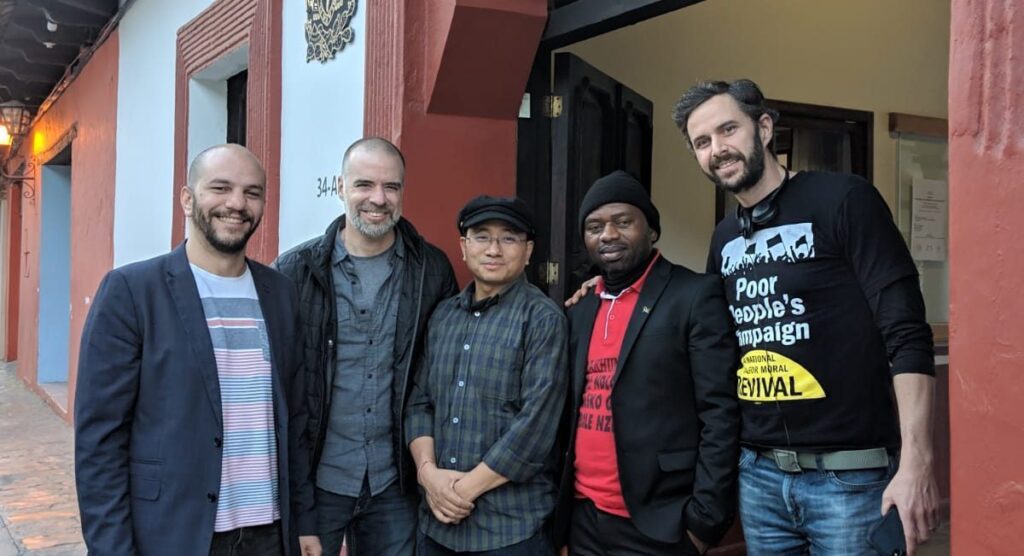
Recently the Kairos Center was invited by the Network for Economic, Social, and Cultural Rights (ESCRnet) to be part of a five-day workshop with social movement leaders from across the world to discuss and develop an analysis of the dominant economic system.
[aesop_image img=”https://kairoscenter.org/wp-content/uploads/2019/03/IMG-2055-e1553906441695.jpg” panorama=”off” align=”center” lightbox=”on” caption=”Streets of San Cristobal de las Casas, in the state of Chiapas, Mexico.” captionposition=”left” revealfx=”off” overlay_revealfx=”off”]
Our gathering took place near San Cristobal, a vibrant, culturally rich town in Chiapas, the southernmost state of Mexico. Chiapas has a long history of social resistance. The Zapatista movement grew out of the struggles of indigenous communities in Chiapas. On January 1, 1994, the North American Free Trade Agreement (NAFTA) went into effect. On the same day the Zapatistas overtook and occupied three cities in Chiapas, including San Cristobal. This marked the beginning of armed struggle with the Mexican State and paramilitary forces. The Zapatistas, like most indigenous and small farming communities viewed NAFTA and other policies of the state as a direct threat to their lives and livelihoods.
[aesop_image img=”https://kairoscenter.org/wp-content/uploads/2019/03/unnamed.jpg” panorama=”off” align=”center” lightbox=”on” caption=”Sign in a nearby town declaring autonomy and alliance with the Zapatista Army of National Liberation (EZLN).” captionposition=”left” revealfx=”off” overlay_revealfx=”off”]
In the ten years following the signing of NAFTA it is estimated that 1.5 million small farmers have been displaced in Mexico. The Chiapas region is rich in natural resources and also has the highest rate of poverty in Mexico. Nearly 75% of the population lives in poverty. To this day, indigenous communities continue to organize and resist the efforts of global mining and energy companies to exploit the riches of Chiapas. Our hosts, Otros Mundos, have been closely involved with these struggles in Chiapas and across Mexico for decades.
Part of our week included a public panel discussion with students and activists in a community center in San Cristobal. Otros Mundos wanted to share and hold a discussion about the work that was being done to fight for human rights in other parts of the world.
[aesop_image img=”https://kairoscenter.org/wp-content/uploads/2019/03/95de508b-62e1-4117-bb3b-04675e94aa6f.jpg” panorama=”off” align=”center” lightbox=”on” caption=”Public panel discussion in San Cristobal on global human rights struggles at the Centro de Investigaciones Multidisciplinarias sobre Chiapa y la Frontera Sur.” captionposition=”left” revealfx=”off” overlay_revealfx=”off”]
The panel was diverse and powerful. S’bu Zikode, president of Abahlali base Mjondolo, represented the shack dwellers movement in South Africa. Zenayda Serrano of El Salvador is a leader with MUFRAS 32 (Movimiento Unificado Francisco Sánchez-1932). She shared how their efforts recently led to an historic victory that bans all metal mining in El Salvador. We also heard from Osama Diab of the Egyptian Initiative on Personal Rights (EIPR), an organization fighting for the human rights of Egyptians under conditions of serious state repression, and from Sanam Amin of Thailand and the Asia Pacific Forum on Women, Law and Development (APWLD), which has helped unite and build power among poor and marginalized women across the Asia region for over 30 years.
I was invited to be on the panel and share the work of the Poor People’s Campaign: A National Call for Moral Revival. The crowd was somewhat shocked at the numbers I shared from the Campaign’s recent audit of the conditions in the U.S.: 140 million poor and low income people (43% of the population), 14 million people that can’t afford water, 250,000 poverty-related deaths a year.
Many of the questions from the audience were directed at me. There was doubt and surprise at these conditions and in general at the claim that poverty was a real issue in the United States. I made the point that similar doubts about the extent of poverty are common in the U.S. These doubts are shared by rich and poor alike. I went on to explain that a big part of our struggle is against a narrative that asserts there isn’t any “real” poverty in the US and whatever does exist is primarily the result of individual failings (poor people who are lazy, crazy criminals).
The Souls of Poor Folks Audit and the growing struggle of the poor in the U.S. proves otherwise. The reality is that the massive profits gained by multinational corporations, like those ravaging the land and displacing people in El Salvador and Mexico, enrich the lives of only a few people. The vast majority of people in the U.S. do not benefit from the activities of these corporations.
By sharing our analysis of the conditions in the U.S., and more importantly by sharing the growing organization and struggle of the poor that helped guide and produce this analysis, we begin to identify the common systemic sources of suffering. Whether we are in the U.S. or Mexico or Congo there is a common basis for global solidarity and movement building — the system that produces and benefits from poverty.
[aesop_quote type=”block” background=”#31526f” text=”#ffffff” align=”left” size=”1″ quote=”There is a common basis for global solidarity and movement building — the system that produces and benefits from poverty.” parallax=”off” direction=”left” revealfx=”off”]
In many parts of the world, like Chiapas, this system is well known and serious efforts to resist and imagine different ways have been active for many decades. To a large extent the poor in the U.S. are only beginning to awaken to the reality of this system, call it by name, and actively organize against it. Rev. Dr. Martin Luther King Jr. was moving in this direction with the original 1968 Poor People’s Campaign. His assassination was a clear indication of the threat that a united, conscious force of the poor could pose to a system that is premised on the creation of poverty.
Since King’s death the poor in the U.S. have been minimally sustained through welfare programs (which are constantly under attack), intentionally divided and pitted against each other through the reinforcement of differences in race, sexuality, gender, religion, geography, and lulled into isolation and inaction by an ideology that claims the U.S. is the most prosperous nation the world has ever known, whose system of Democracy and Capitalism is the best and last hope for all humanity. The growing failures of this system have produced conditions to help awaken what King called “a new and unsettling force,” and bring the millions of poor people in the U.S. in closer solidarity with the poor across the world.
To end poverty in the U.S. or in Chiapas, we must build a global movement. The leaders we assembled in Chiapas didn’t always agree on the details of what we were facing or how to build such a movement, but there was no disputing the global nature of it. One significant step we took together was putting together an initial timeline of Capitalism.
[aesop_image img=”https://kairoscenter.org/wp-content/uploads/2019/03/IMG-2099.jpg” panorama=”off” align=”center” lightbox=”on” caption=”The first draft of a timeline of Capitalism.” captionposition=”left” revealfx=”off” overlay_revealfx=”off”]
This exercise allowed us all to learn more about this system and how it operates. It also helped us see the different stages and hear how they impacted different regions of the world differently, but perhaps most importantly, the exercise reminded us of the temporal nature of this system. It is a system developed and supported by humans. It had a beginning, and it can have an end.
[aesop_quote type=”block” background=”#31526f” text=”#ffffff” align=”left” size=”1″ quote=”Capitalism is a system developed and supported by humans. It had a beginning, and it can have an end. ” parallax=”off” direction=”left” revealfx=”off”]
Having these conversations in Chiapas with fighters from around the world reinforced the importance of what we are doing in the U.S. with the Poor People’s Campaign: A National Call for Moral Revival. By organizing and building up the power of the poor in the U.S. we are not just aiming to end destructive policies and replace misguided political leaders. Through this work we hope to ultimately join with the poor around the world and confront the global system that survives and thrives on dehumanizing policies and idolatrous politicians. We stand in solidarity with the shack dwellers in South Africa, the poor farmers and fisher people in Sri Lanka, and the indigenous communities from Chiapas, to Thailand, to Bangladesh, not because we in the U.S. can be their savior, but because our collective salvation depends on the end of this system and the collective beginning of something more just.