My experience in Selma reinforced the idea that those who control history, control the future. Constructed narratives about the past direct policy decisions and influence the movement of the masses. One of the chief strategic goals of the new Poor People’s Campaign is to expose the way that systemic inequality continues to affect the lives and possibilities of vast numbers of people. The narrative being shaped during the weekend of the 50th anniversary of the Edmund Pettus Bridge crossing was in direct contradiction to the daily-lived experience of the residents of Selma today. In our brief tour, the Kairos Center and other activists and organizers with the call for a new Poor People’s Campaign saw first hand the poverty and disenfranchisement that exists in the shadow of received history.
While preparations were being made in downtown Selma in anticipation of the President’s speech and the festivities accompanying the bridge crossing, we were at a local auto parts manufacturing plant standing in solidarity with Lear Corporation workers facing troubling and debilitating working conditions. The workers have few options for employment and even fewer when it comes to affording the costs of healthcare and advocating for fair treatment.
[aesop_image img=”https://kairoscenter.org/wp-content/uploads/2015/04/auto-workers-3.jpg” alt=”Selma Today” align=”center” lightbox=”on” caption=”Standing with Selma auto worker Kim King” captionposition=”left”]
In Lowndes County, we saw broken down husks of buildings standing in the heart of the birthplace of the Black Panther Party movement. These buildings are ready to collapse and present a real danger to citizens maintaining businesses adjoining the failing structures. People live in homes with open sewage draining systems in their backyards where children play along side trenches filled with flowing human waste. We visited the house of a woman who had been living for over thirty years under constant threat of the lagoon across the street overflowing with solid waste and seeping into her front lawn and plumbing. The smell of excrement filled the frozen air and we could only imagine what the smell is like on a hot Alabama summer day. This is the state of existence for thousands of residents in communities around Selma. These are the battles that are being waged from the bottom as the celebration of the legacy of Martin Luther King was taking place.
[aesop_image img=”https://kairoscenter.org/wp-content/uploads/2015/04/lowndes-4.jpg” alt=”Selma Today” align=”left” lightbox=”on” caption=”Catherine Flowers of the Equal Justice Initiative shows us the conditions in Lowndes County” captionposition=”left”]
We also visited the monument erected to the Confederate General and Ku Klux Klan leader Nathan Bedford Forrest. This monument to racialized violence and hatred is mere miles away from the “Freedom Trail” established to control the version of Selma experienced by visitors and site seers. The sanitization of the Civil War, including its ultimate cause and the conditions of brutality that existed in the South both before its beginning and after its conclusion, is another example of the way that history is being used to control the future.
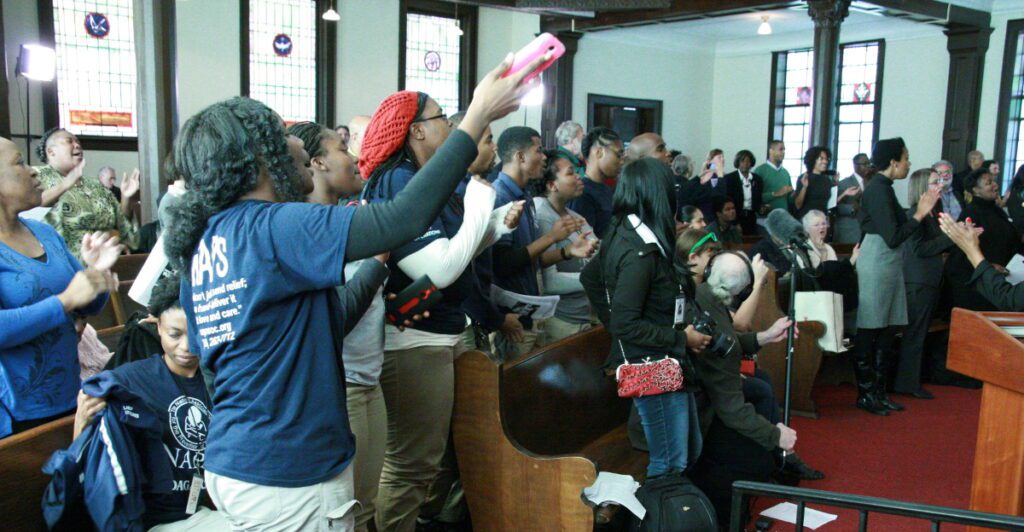
On Friday, March 6th at the historic Brown Chapel A.M.E. Church, the Poor People’s Campaign delegation to Selma held an event – “Community Hearing on Poverty: A Renewal of Rev. Dr. King’s Poor People’s Campaign. The power of that event came from our intense commitment to hearing the stories of those who experience tragic living conditions amidst the inequity in Selma. Sherry Mitchell led us through the struggle of Selma’s public housing residents and their inability to move those in power. As the victories gained over fifty years ago in the Voting Rights Act are systematically rolled back, the power of communities to control their own fate and advocate for themselves has also been undermined. This is not a coincidence – Selma is a microcosm for the fate of the Global South as it contends with entrenched structures of power which have a stake in maintaining at all costs the myth of advancement and parity.
This myth is foundational to the project of controlling the American poor. The poor are led to believe that if they only worked harder, longer hours with less protections, they would get a slice of the proverbial American pie of prosperity and safety. They are led to believe that poverty is a fault of character, not the fault of structures and privileges based in inequality and the subversion of basic human rights and expectations. The American dream does not reflect reality and the Protestant Work Ethic is used to justify wage slavery.
[aesop_image img=”https://kairoscenter.org/wp-content/uploads/2015/04/hearing-crowd-active.jpg” alt=”Selma Today” align=”center” lightbox=”on” caption=”Participants in the Community Hearing on Poverty in Selma Today” captionposition=”left”]
In his speech at the base of the Edmund Pettus Bridge, Pres. Obama said, “There are places, and moments in America where this nation’s destiny has been decided. Many are sites of war – Concord and Lexington, Appomattox and Gettysburg. Others are sites that symbolize the daring of America’s character…Selma is such a place.” Selma is both a symbolic site of resistance to unchecked state power and a war zone where the character of the United States is being decided. We must decide whether we will value received history and nostalgia over human dignity and the sacred nature of life.
America’s character celebrates suffering over and above the ability for those at the bottom of society to thrive. It is all too easy to remember Martin Luther King and John Lewis taking the bridge as a mere moment in history, a moment to reenact yearly with no thought to current conditions. Later in his speech, Obama declared, “We know the march is not yet over, the race is not yet won, and that reaching that blessed destination where we are judged by the content of our character – requires admitting as much.” It is hard to face the reality that not only is the march not over, but that it must be reignited in the hearts and minds of an American public who see the ascendancy of Pres. Obama as the culmination of the race and not its beginning. We managed to elect a Black man president in a land of profound and deep bigotry and racism. We also have the power to end poverty and to live into the promise of our sacred character. We control the future by daily encountering the past in our continued struggle for equality.