
“For we wrestle not against flesh and blood, but against principalities, against powers, against the rulers of the darkness of this world, against spiritual wickedness in high places.”
– Ephesians 6:12 (NIV)
“The history of Louisiana, from 1870 to 1876, reads like a Chinese puzzle to those who forget the great forces below…Beneath the witch’s cauldron of political chicanery, it is difficult to remember the great…mass of white and black labor, the overwhelming majority of the citizens of Louisiana, groping for light, and seldom finding expression. Historians quite unanimously forget and ignore them, and chronicle only the amazing game of politicians.”
– W.E.B. Du Bois, Black Reconstruction in America
The chaos, corruption, opportunism, and oppression that came after the human disaster of the Civil War took a particularly blatant form in Louisiana. A truly just Reconstruction was undermined at every turn by “spiritual wickedness in high places” and the “witch’s cauldron of political chicanery.” However, that was far from the whole story: In the face of oppression, masses of people, Black and white, struggled to build a better for their families and communities.
Almost ten years ago, Katrina brought another disaster to Louisiana. And let’s be clear – Katrina was a disaster, like war, made by human hands. Much like after the Civil War, the oppression that has come after Katrina has been bold and deadly. It reminds me of the situation in Central Appalachia: The Powers that Be don’t even try to hide their wickedness. The age old Plantation Politics of racial oppression and pitting the poor against the poor is alive and well in the Crescent City, as it is throughout the South and the nation at large. Louisiana is the incarceration capital of the USA, which means it’s probably the incarceration capital of the world. Even among people of color, poor blacks have been pitted against the newer streams of Central American and South Asian immigrant workers. But that’s far from the whole story. It seems to me that there has been far more said about the plight of the poor and too little has been said about the fight and insight of the poor. The whole story needs to be told! We must never lose sight of the “great forces below…groping for light.”
STAND with Dignity
[aesop_image img=”https://kairoscenter.org/wp-content/uploads/2014/12/5.jpg” credit=”Jose Vasquez” align=”center” lightbox=”off” captionposition=”left”]
STAND with Dignity, a worker-led group operating under the New Orleans Worker’s Center for Racial Justice, is one expression of those great forces. Here’s how they define their mission:
To Define, Create, and Speak for Ourselves
STAND is a grass-roots organization of low-income residents and workers in New Orleans. As survivors, we believe unity and self-determination are our most viable solutions. Now more than ever, when City, State, and Federal government have turned their backs, we believe grassroots leaders must come together to take collective action to change our condition. We seek to transform all systems of exploitation and racism through organizing the power of the working poor. To this end, we pledge to ensure the rights of workers and residents to return and recover.
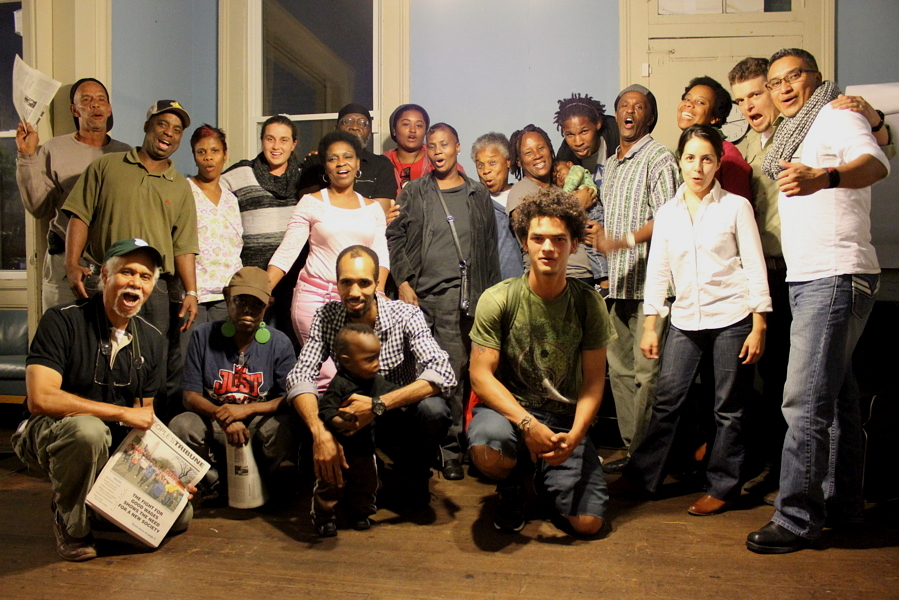
It’s a Tuesday night and leaders from Stand with Dignity gather for their weekly leadership meeting. The Workers’ Center is located in an old house just blocks away from Congo Square – the site where for generations slaves gathered as a community on Sundays beyond the gaze of their oppressors.
The Kairos Center is a few days into our inaugural reconnaissance tour for the Poor People’s Campaign. We have selected the Gulf Coast for our first tour, keeping in mind that next year will be the ten year anniversary of Katrina and the five year anniversary of the BP oil spill. Our team is made up of Jose Vasquez of Iraq Veterans Against the War; Luis Larin from the United Workers of Baltimore; Ashley Hufnagel from the Oak Hill Center for Education and Culture, also in Baltimore; Rev. Jennifer Bailey from Nashville, TN, founder of the Faith Matters Network; and Willie Baptist and myself from the Kairos Center.
The leaders of STAND graciously have invited us to participate in the meeting. The room fills up to the point that people start to spill out into the next room. The group is by and large black. We are struck by its intergenerational composition, most vividly represented by a grandmother holding her toddler granddaughter in her lap for most of the meeting. The group has plenty of young leaders. Women and men. Queer and straight. From the outset, it is clear that, when it comes to leadership, STAND with Dignity has a deep bench. The energy is strong here. Serious and engaged, warm and funny. It’s the kind of scene that makes you feel your heart grow.
[aesop_quote background=”#507b96″ text=”#ffffff” align=”center” size=”2″ quote=”You win some, and you lose some. But the only permanent thing they can’t take from you is the leadership that comes from the struggle. That leadership can’t be lost, and it must be nurtured.” parallax=”off” direction=”left”]
Toya, an organizer who comes from the community, facilitates the meeting with skill, grace, and compassion. It’s the mid-term national elections today. So we open up with two questions for the group: 1.) Did you vote today? 2.) Why or why not? It turns out most people voted, but some didn’t. Why or why not? For some, voting is a sacred right, and there should be no excuse not to exercise that right. For others, due to work, they had no time. Others are barred from voting due to prior convictions. And a number of younger leaders express skepticism about what good it does.
We are given the floor to introduce our team and talk about our call to re-ignite Dr. King’s Poor People’s Campaign. Afterwards, leaders take turns telling us their story as an organization. The original leaders were residents of the B.W. Cooper Public Housing Complex otherwise known as the Calliope Projects (that’s pronounced Call – ee – ope).
[aesop_image img=”https://kairoscenter.org/wp-content/uploads/2014/12/3.jpg” align=”center” lightbox=”off” caption=”Members of STAND with Dignity at their leadership meeting” captionposition=”left”]
Listening to these leaders, it is clear they’ve developed a collective analysis. They eloquently describe what they have learned through victories as well as failures. They tell us about the real challenges they have confronted. They articulate what has been revealed to them through their campaigns and those challenges about the systemic nature of the problems facing their community. At one point, one of the leaders, Roy, talks about seeing the “law of circumvention” clearly at work in their struggle – how their adversaries have been able to turn their victories against them. So often, we on the grassroots level raise up only our victories, especially to strangers, but STAND leaders are confident enough to speak with honesty.
STAND has won a number of concrete victories, but they have no illusions about what they’re up against. The truth is they have accomplished something more powerful than concessions. Ted Quant, an adviser to STAND who happens to be one of Willie’s oldest friends, articulates it best: “In this work, you do your homework. You make a fight. You win some, and you lose some. But the only permanent thing they can’t take from you is the leadership that comes from the struggle. That leadership can’t be lost, and it must be nurtured.”
The evening we spent with STAND was a highlight of our entire week. We end the meeting, in a circle hand in hand. A leader offers a powerful prayer, and we finish by chanting the words of Assata Shakur:
“It is our duty to fight for our freedom. It is our duty to win. We must love each other and support each other. We have nothing to lose but our chains.”