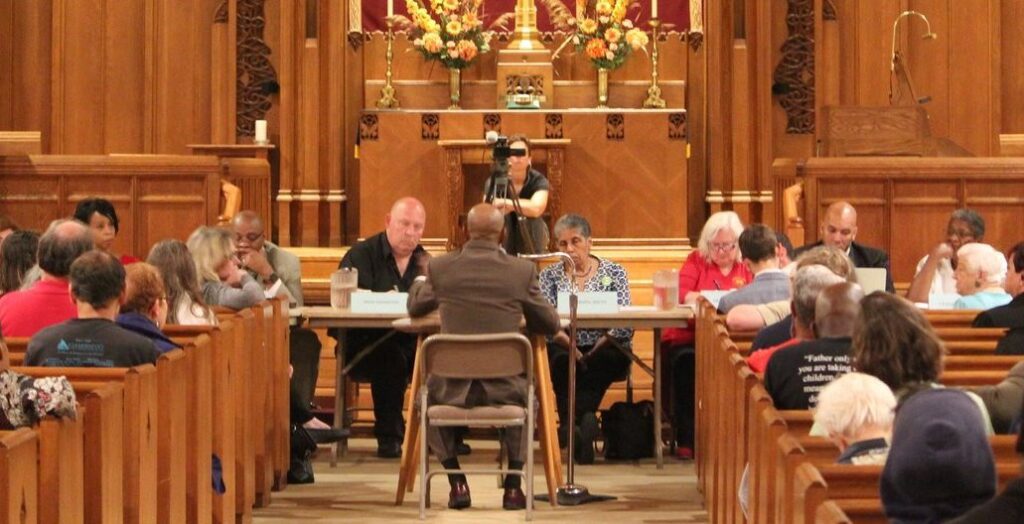
On Thursday, July 13, I served as a Commissioner to the Truth Commission on Poverty in Schenectady, New York. Organized by the New York Labor-Religion Coalition, this was the second in a series of truth commissions being held this summer. This series will culminate on October 16-18 in Binghamton, where the findings of these commissions will be consolidated and publicized as part of the activity building up in New York State around a national call for a Poor People’s Campaign. This call is being raised by Rev. Dr. William Barber II (Repairers of the Breach), the Kairos Center for Religions, Rights and Social Justice at Union Theological Seminary, and a growing number of grassroots and community organizations and churches across the country.
As several people testified, poverty is the “worst form of violence.” It is a “constant battle” against an enemy that demands sacrifices of our families, our parents, our children, of everything that we hold dear. And it terrorizes our communities in the places where we think we’re protected.
Indeed, the testimonies offered this evening raised questions about the ability of public institutions to care for the general welfare. A Fight for $15 fast food worker testified to the challenges of raising her four children in a household with two working parents. Their family struggles with the question of having to pay either their rent or their electricity bill. And as she recognized, “a lot of people have stories like [hers].” In fact, the truth commission revealed the apparently systemic inability of the Department of Social Services to respond to families in financial crisis. One testifier, a case manger for a social service organization, said that not once in her four years of social work had she encountered someone who had received assistance from DSS in the form of welfare payments from the Temporary Assistance for Need Families (TANF) federal program. Instead, families and individuals were being turned away from federally funded state welfare programs towards non-profits and charitable assistance. An institution set up to provide care and service to people at their most vulnerable times was not able or willing to do so.
This kind of abandonment was also present in Veterans’ Affairs, the Department of Corrections and juvenile justice systems, and immigration. One testifier’s insight cut straight through to the heart of matter. He said, “Poverty doesn’t cause injustice. Injustice causes poverty.” This injustice is rooted in an economic and political system that cannot provide living wages, affordable housing or decent healthcare to everyone. Rather, as another testifier concluded, this system creates these conditions of poverty to keep itself going. She asked, “how can we bring change in a society that wants to get rid of poverty, but can’t function without it?”
Indeed, while the relentless and systemic violence we’re facing relies on our fear and isolation, it does not account for the amazing bravery that is standing up in Schenectady saying that, “poverty does not have a color, a shape, or a religion.” It does not account for the people who say, first, “I shouldn’t have to live like this,” and then the community that says, “we shouldn’t have to live like this.” This move from “I” to “we” is a love that the enemy we’re up against does not account for, because it cannot conceive of it. But it is deep in that love — in the ability to see each other and ourselves for who we truly are and what we hold and fight for together — that we will win.